
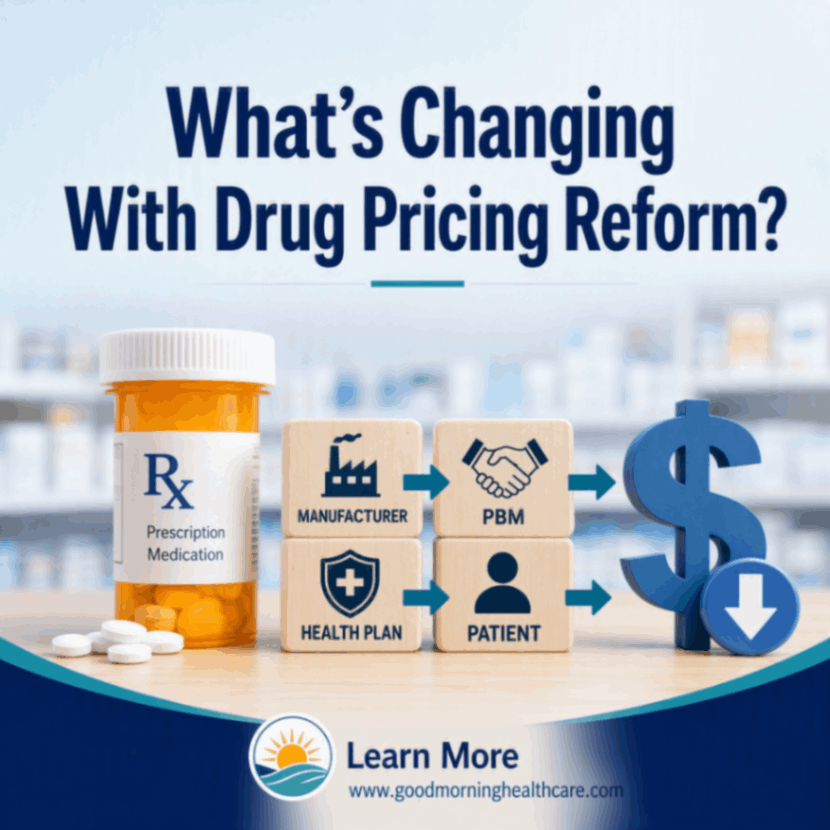
A prescription drug can have several different prices before it reaches the pharmacy counter: the manufacturer’s list price, the amount a health plan ultimately pays, and the patient’s out-of-pocket cost.
Between those transactions often sits a pharmacy benefit manager (PBM).
PBMs negotiate with drug manufacturers, develop formularies, contract with pharmacies, process prescription claims, and often operate mail-order or specialty pharmacies. Supporters say PBMs use their purchasing power to reduce prescription drug costs. Critics argue that complex contracts, rebates, fees, and affiliated businesses can make it difficult for employers, pharmacies, and patients to see where the money goes.
That is driving growing interest in PBM pricing transparency and PBM reform.
What Is PBM Pricing Transparency?
PBM pricing transparency means giving employers, health plans, regulators, pharmacies, and—in some cases—patients more information about how prescription drug dollars move through the supply chain.
The goal is not necessarily to create one universal price for every prescription. Instead, reform efforts increasingly focus on making it easier to identify:
- Manufacturer rebates and discounts
- PBM administrative fees
- Pharmacy reimbursement
- Spread pricing
- Payments between affiliated companies
- Formulary and network incentives
- The relationship between negotiated prices and patient out-of-pocket costs
Federal law already requires certain group health plans and insurers to report prescription drug spending information to federal agencies under the Consolidated Appropriations Act.
U.S. Department of Labor: Prescription Drug and Health Care Spending Reporting
But reporting requirements do not automatically mean an employer or patient will receive a simple answer to the question: “What did this prescription really cost?”
Why PBM Pricing Is Complicated
The prescription drug supply chain can involve several financial transactions.
For example, a PBM may negotiate a rebate with a manufacturer, reimburse a pharmacy at one rate, and charge a health plan another amount.
Spread Pricing
With spread pricing, a PBM charges a health plan more than it reimburses the pharmacy and keeps the difference.
Spread pricing is not universally prohibited, but it has attracted scrutiny when employers or government programs cannot easily determine how large the spread is.
Several states have adopted PBM transparency requirements, while others have restricted spread pricing in certain markets. The National Conference of State Legislatures reports that states have increasingly focused on PBM reporting, rebates, fees, and spread pricing.
National Conference of State Legislatures: PBM Reform
Rebates
Manufacturer rebates are another major source of debate.
A manufacturer may provide a rebate in exchange for favorable formulary placement or other arrangements. Those rebates can reduce a health plan’s overall spending, but the savings may not directly reduce what a patient pays at the pharmacy counter.
This creates an important distinction:
A lower net cost for a health plan does not necessarily mean a lower out-of-pocket cost for the patient.
What Is Changing in PBM Reform?
There is no single national PBM pricing rule. Instead, reform is happening through federal enforcement, state legislation, transparency requirements, and changes to employer and health-plan contracts.
1. More scrutiny of PBM business practices
The Federal Trade Commission (FTC) has significantly increased its focus on PBMs, including their relationships with drug manufacturers, pharmacies, and affiliated businesses.
In 2026, the FTC reached settlements involving major PBMs that include changes intended to increase transparency, address pharmacy practices, and reduce certain patient costs. Its February 2026 settlement with Express Scripts, for example, called for business-practice changes that the FTC says could reduce patient out-of-pocket costs for insulin by billions of dollars over 10 years.
Federal Trade Commission: Pharmacy Benefit Managers
The FTC also announced a July 2026 settlement involving Caremark that includes additional transparency and community-pharmacy provisions.
2. Greater transparency for employers
Employers and other plan sponsors increasingly want to know exactly how their PBM is compensated.
Important questions include:
- Are rebates fully passed through?
- What administrative fees are being charged?
- Is spread pricing allowed?
- How are pharmacies reimbursed?
- Does the PBM favor affiliated pharmacies?
- What audit rights does the employer have?
- Can the employer see actual net drug costs?
For large employers, detailed reporting can make PBM contracts easier to evaluate. Smaller employers may still need consultants or outside experts to interpret complex data.
Transparency provides information—but information only creates savings if buyers can use it to negotiate better contracts.
3. More attention to independent pharmacies
Independent and rural pharmacies are particularly concerned about reimbursement levels and PBM network practices.
When pharmacy reimbursement does not keep pace with acquisition costs, pharmacies can face pressure to reduce services, renegotiate contracts, or close locations.
Why So Many Pharmacies Are Closing
The policy challenge is balancing pharmacy sustainability with the need to control health-plan and taxpayer spending.
4. Scrutiny of vertically integrated PBMs
The largest PBMs may be connected to health insurers, mail-order pharmacies, specialty pharmacies, and other healthcare businesses.
Vertical integration can create efficiencies and make it easier to coordinate care. But it also raises questions about potential conflicts of interest.
For example, a health plan or PBM may steer prescriptions toward an affiliated specialty or mail-order pharmacy.
That does not automatically mean the arrangement is harmful. The important question is whether patients and plan sponsors can understand why a pharmacy or medication option was selected and whether the financial incentives are transparent.
What Does PBM Reform Mean for Patients?
Patients usually care less about the technical details of PBM contracts than one simple question:
How much will I pay for my prescription?
That is why PBM transparency is increasingly connected to consumer-facing pricing tools, lower-cost alternatives, formulary design, and pharmacy choice.
Patients can ask:
- Is there a generic or biosimilar alternative?
- What will I pay at different pharmacies?
- Is a 90-day supply less expensive?
- Does my plan require a specific specialty pharmacy?
- Is there a lower-cost covered alternative?
- Would the cash price be lower than my insurance price?
For expensive specialty medications, the formulary and specialty-pharmacy rules can be just as important as the manufacturer’s advertised price.
Why Specialty Drugs Are Driving Healthcare Costs
Medicare Is Also Changing Prescription Drug Costs
Not every prescription drug pricing reform is a PBM reform.
The Inflation Reduction Act significantly changed Medicare Part D. Beginning in 2025, Medicare Part D beneficiaries received a $2,000 annual out-of-pocket cap for covered prescription drugs. The cap increased to $2,100 in 2026.
Medicare also introduced the Medicare Prescription Payment Plan, allowing Part D enrollees to spread eligible out-of-pocket prescription costs across monthly payments rather than paying the full amount at the pharmacy.
CMS: Medicare Prescription Payment Plan
These policies do not directly regulate PBM pricing, but they illustrate the broader shift toward making prescription drug costs more predictable and affordable for consumers.
What Should Employers Watch?
For employers negotiating or renewing a PBM contract, transparency should go beyond asking for a lower administrative fee.
Key questions include:
- How are PBM revenues calculated?
- Are manufacturer rebates fully passed through?
- Is spread pricing permitted?
- How are pharmacies reimbursed?
- How are affiliated pharmacies treated?
- What data and audit rights does the employer receive?
- Can the employer measure actual net drug spending?
A PBM with a low administrative fee is not necessarily the lowest-cost option if the contract allows significant revenue elsewhere.
The Bottom Line: Transparency Is Only the First Step
PBM pricing reform is moving toward greater visibility into rebates, fees, pharmacy reimbursement, spread pricing, and conflicts of interest. Federal agencies are increasing scrutiny, states are adopting different transparency and PBM rules, and employers are demanding more detailed contract information.
But transparency alone will not guarantee lower prescription prices.
The real test is whether the new information allows employers to negotiate better contracts, pharmacies to understand reimbursement, policymakers to identify problematic practices, and patients to see what they will actually pay.
The ultimate measure of PBM reform is therefore simple:
Can people making prescription-drug decisions see enough of the money trail to make better decisions—and can those decisions actually lower the cost of care?
Thank you, You will be automatically subscribed to the our newsletter.