
A package can say “natural,” “made with whole grains,” or “supports heart health” and still leave shoppers with plenty to sort out.
Food labels provide important nutrition and safety information, but they are not a shortcut for deciding whether a food is right for you. Knowing how to read a food label can help you make better choices about sodium, added sugar, fiber, calories, allergies, and overall nutrition.
Start With the Serving Size
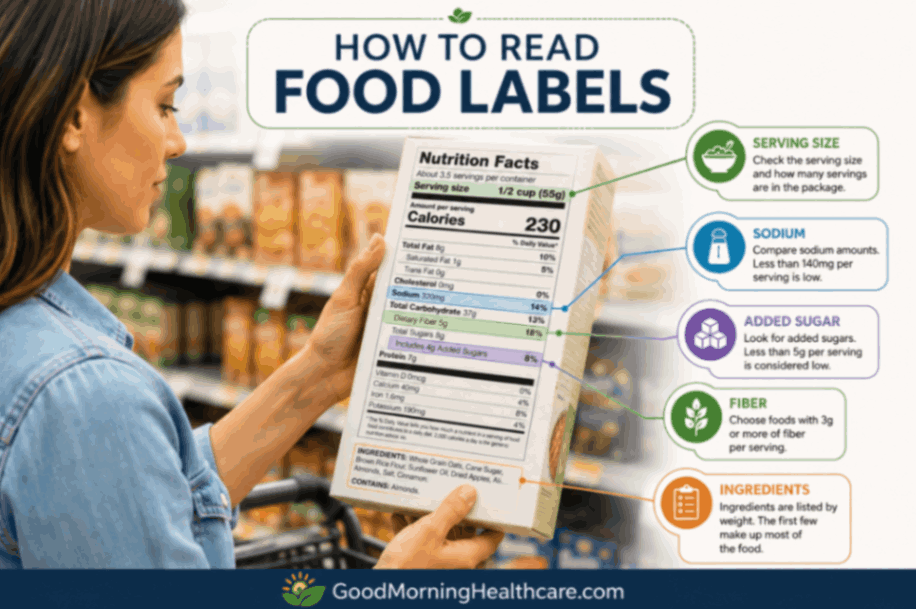
The Nutrition Facts label is one of the most useful parts of a food package, but start with the serving size.
Calories, sodium, saturated fat, fiber, and added sugars are generally listed per serving, not necessarily per package.
For example, a drink with 130 calories and 26 grams of added sugar may seem reasonable until you notice the bottle contains two servings. Drinking the entire bottle would provide twice those amounts.
The FDA says serving sizes are based on amounts people typically consume, rather than how much they should eat. FDA: Understanding Serving Size
Also look at the % Daily Value (%DV). As a general guide, 5% DV or less is low, while 20% DV or more is high.
Pay Attention to Sodium, Added Sugar and Fiber
Calories matter, but several other numbers deserve close attention.

Sodium
Too much sodium can contribute to high blood pressure, an important risk factor for heart disease and stroke.
Sodium can add up quickly in packaged soups, breads, sauces, deli meats, frozen meals, and snacks. A food does not necessarily have to taste salty to contain significant sodium.
The FDA provides guidance on how to identify and reduce sodium in your diet. FDA: Sodium in Your Diet
You can also read our guide to high sodium intake and heart health.
Added Sugar
The Nutrition Facts label separates added sugars from total sugars.
Total sugars include naturally occurring sugars, such as those in fruit and milk, as well as added sugars. Added sugars are put into foods during processing.
For example, plain yogurt contains naturally occurring lactose, while flavored yogurt may contain lactose plus added sugar.
The FDA lists 50 grams per day as the Daily Value for added sugars based on a 2,000-calorie diet. FDA: Added Sugars
Fiber
Fiber supports digestive health and can be part of an eating pattern that supports heart and metabolic health.
When comparing foods, look for products that provide meaningful amounts of fiber. But don’t stop at a “high-fiber” claim. Check the rest of the label for sodium, added sugar, and other nutrients.
Read the Ingredient List
The ingredient list tells you what is actually in the food.
Ingredients are generally listed in descending order by weight. If sugar, refined flour, or another major ingredient appears near the beginning, it represents a substantial part of the product.
Don’t assume an unfamiliar ingredient is automatically unhealthy. Many technical-sounding names are vitamins, preservatives, stabilizers, or other ingredients used to maintain a food’s quality.
The ingredient list can also help you evaluate products marketed as whole grain, fruit-based, or protein-rich.
Check for Food Allergens
For people with food allergies, carefully reading the label is essential.
U.S. law recognizes nine major food allergens: milk, eggs, fish, crustacean shellfish, tree nuts, peanuts, wheat, soybeans, and sesame. FDA: Food Allergies
Look for the ingredient list and a separate “Contains” statement when present.
People with serious allergies should also pay attention to voluntary warnings such as “may contain” or statements about shared equipment or facilities. These warnings address possible cross-contact and are different from ingredients intentionally added to the food.
Don’t Trust Every Front-of-Package Claim
Words on the front of a package are designed to attract attention. Some claims have specific regulatory definitions, while others can be broader marketing language.
For example:
- “Low sodium” has regulatory criteria.
- “Reduced fat” means reduced compared with an appropriate reference product.
- “No added sugar” does not mean sugar-free.
- “Natural” does not automatically mean organic, minimally processed, or highly nutritious.
- “Made with real fruit” does not tell you how much fruit is actually in the product.
The FDA provides detailed information about nutrient and health claims on food labels. FDA: Food Label Claims
What Food Labels Don’t Tell You
A food label provides standardized information, but it cannot tell you everything about how a food fits your health needs.
It does not show exactly how filling a food will be, how it will affect an individual’s blood sugar, or whether it fits someone’s overall eating pattern.
For example, a reduced-sodium frozen meal may be a better choice than the original version but still provide a significant amount of sodium.
Individual health needs matter, too. Our guide to early signs of insulin resistance provides additional information about blood sugar and metabolic health.
A Simple 5-Step Way to Read Food Labels

When comparing packaged foods:
1. Check the serving size.
Know how much the label considers one serving.
2. Look at calories.
Consider how many servings you actually eat.
3. Check sodium, saturated fat, added sugars and fiber.
Look for nutrients you may want less of and nutrients you may want more of.
4. Read the ingredient list.
Don’t rely only on claims printed on the front of the package.
5. Treat health claims as a starting point.
A product that sounds healthy still deserves a look at the Nutrition Facts panel.
The goal isn’t to find a perfect food. It’s to make the next grocery decision with a little more clarity—whether that means choosing a lower-sodium soup, recognizing two servings in a bottled drink, finding a higher-fiber cereal, or avoiding an ingredient that could trigger an allergy.
Small label-reading habits can make everyday food choices easier, clearer, and healthier.
Thank you, You will be automatically subscribed to the our newsletter.