
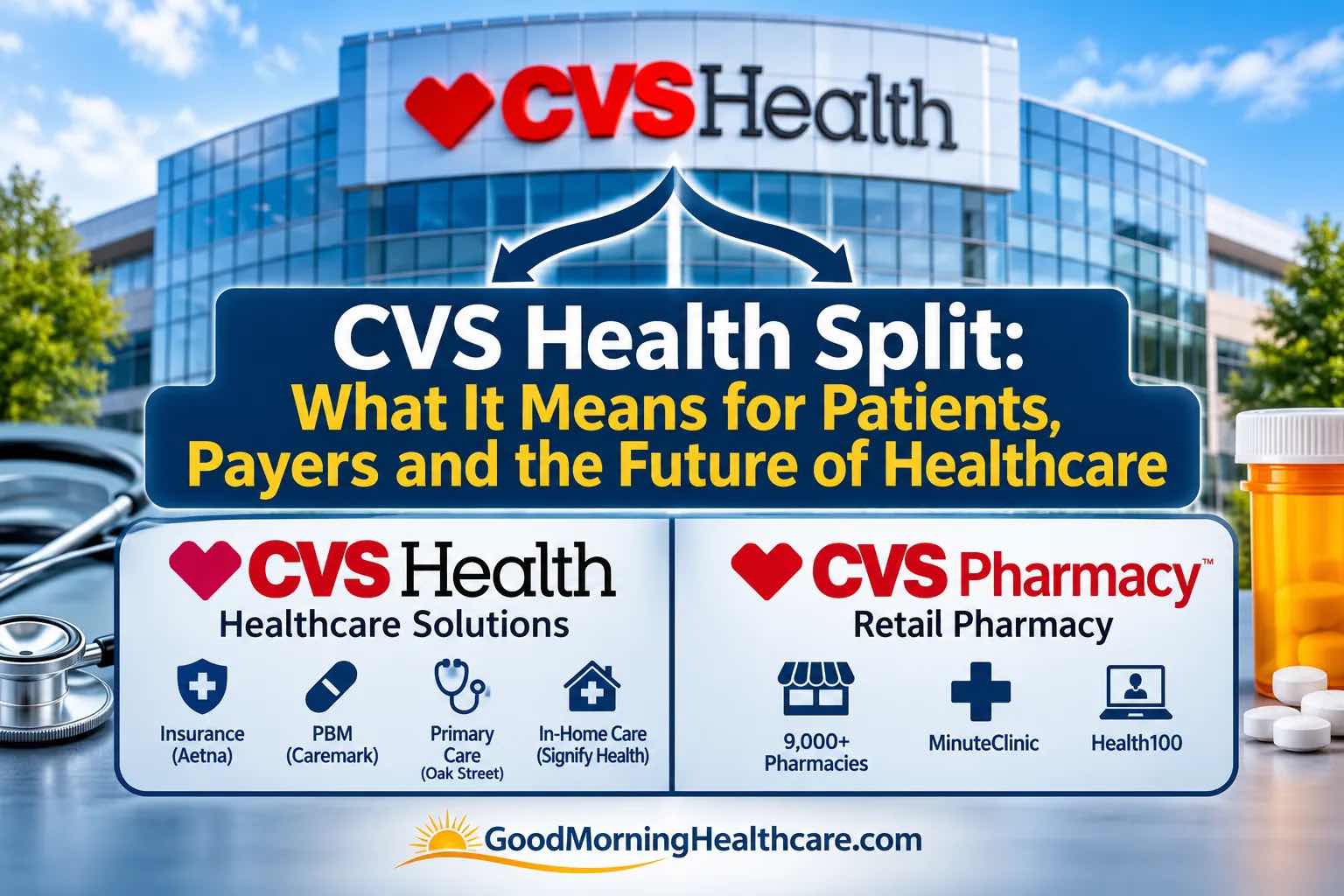
CVS Health’s decision to split into two publicly traded companies could become one of the most consequential changes in the U.S. healthcare industry in recent years. Announced on November 4, 2026, the planned separation marks a significant shift in strategy for a company that spent years bringing health insurance, pharmacy benefit management (PBM), retail pharmacy, and healthcare delivery under one corporate umbrella.
The proposed restructuring would create two independent companies. One would combine Aetna, CVS Caremark, CVS Specialty, Oak Street Health, and Signify Health under a healthcare solutions business. The other, CVS Pharmacy, would include approximately 9,000 retail pharmacies, mail pharmacy, MinuteClinic, and Health100.
CVS expects the separation to be completed in the first half of 2028, subject to customary approvals and other conditions.
But this is about more than reorganizing a large healthcare company. It raises a fundamental question for the healthcare industry: Can vertical integration still deliver better value when the businesses responsible for paying for, managing, and delivering care operate under different financial and strategic priorities?
The answer matters to patients, employers, health plans, providers, pharmacy benefit managers, and the broader healthcare system.
Why CVS Health Built an Integrated Healthcare Model
For years, CVS Health pursued a strategy of bringing more parts of the healthcare experience under one organization.
Its retail pharmacy network created a direct connection with millions of consumers. CVS Caremark provided pharmacy benefit management services to employers and health plans. Aetna added health insurance capabilities, while acquisitions such as Oak Street Health and Signify Health expanded the company’s presence in primary care and in-home healthcare.
The business rationale was straightforward: greater coordination across insurance, pharmacy, and care delivery could improve patient outcomes while reducing unnecessary healthcare spending.
In theory, an integrated organization could identify members who need additional support, connect them with primary care, improve medication adherence, steer them toward appropriate care settings, and reduce avoidable emergency department visits and hospitalizations.
Combining pharmacy and medical data could also help identify gaps in treatment and opportunities for earlier intervention.
This strategy reflected a broader industry trend. Health insurers acquired physician groups and PBMs, retailers expanded into clinical services, and healthcare providers explored insurance and risk-based arrangements.
The underlying belief was that organizations with greater visibility across the healthcare journey would be better positioned to manage costs and improve quality.
However, integration is easier to justify strategically than to execute operationally. Different business units have different customers, financial objectives, technology platforms, and regulatory requirements. Employers and providers may also question whether an integrated company will recommend the most appropriate or cost-effective service—or favor its own affiliated businesses.
What the CVS Health Separation Will Actually Look Like
An important distinction is that CVS is not proposing to separate all its healthcare businesses into completely independent entities.
Instead, the company plans to organize its assets into two focused businesses.
1. CVS Health: Healthcare benefits, pharmacy services and care delivery
The healthcare solutions company will include:
- Aetna, the health insurance business.
- CVS Caremark, the pharmacy benefit manager.
- CVS Specialty, the specialty pharmacy business.
- Oak Street Health, the primary care organization.
- Signify Health, the in-home and value-based care business.
This structure will preserve important connections between health insurance, pharmacy benefit management, specialty medications, and care delivery.
2. CVS Pharmacy: Retail pharmacy and community healthcare
The second company, which will be named CVS Pharmacy, will include:
- Approximately 9,000 retail pharmacy locations.
- Mail pharmacy operations.
- MinuteClinic, including virtual care.
- Health100 technology services.
The retail pharmacy company will operate independently and have greater flexibility to develop partnerships with health plans, PBMs, drug manufacturers, and other healthcare organizations.
This distinction is important. CVS is not abandoning vertical integration entirely. It is drawing a different boundary around which businesses should operate together.
The healthcare solutions company will retain a significant degree of integration between the payer, PBM, specialty pharmacy, and care delivery businesses. Meanwhile, the retail pharmacy business will be separated from the insurance and PBM operations.
That makes the transaction a more selective restructuring of vertical integration rather than a complete reversal of the strategy.
What the CVS Split Could Mean for Patients
For consumers, the most immediate question is whether the restructuring will change where they receive care, how they fill prescriptions, or what they pay.
In the near term, patients should not expect an immediate change. CVS has stated that customers, patients, and clients will continue receiving their medications, care, benefits, and services without interruption during the separation process.
The planned transaction is not expected to be completed until the first half of 2028.
Over time, however, the separation could influence how patients access pharmacy services, primary care, and health insurance benefits.
An independent CVS Pharmacy could have greater flexibility to establish relationships with multiple health plans and PBMs rather than operating within the strategic priorities of a company that also owns a major insurer and PBM.
That could create opportunities for broader partnerships and potentially more consumer choice.
On the other hand, separating retail pharmacy operations from the insurance and PBM businesses could introduce additional coordination challenges. Medication adherence programs, pharmacy data exchange, care navigation, and patient engagement will need to remain connected across organizations.
Patients should pay attention to practical changes rather than corporate announcements alone. Important considerations include:
- Pharmacy networks: Whether preferred pharmacy arrangements or participating locations change.
- Prescription coverage: Whether formularies, copayments, or utilization management requirements are affected.
- Care access: Whether primary care, urgent care, and virtual care services remain in existing health plan networks.
- Medication management: Whether coordination between pharmacies, clinicians, and health plans remains effective.
Ultimately, patients will judge the separation by whether healthcare becomes easier to access, understand, and afford.
Implications for Employers, Health Plans and PBMs
The proposed CVS restructuring has important implications for employer-sponsored health benefits and the broader PBM market.
Employers that contract with CVS Caremark or Aetna will want reassurance that existing agreements, pricing arrangements, clinical programs, service levels, and reporting capabilities remain intact.
At the same time, separating the retail pharmacy business could change the competitive dynamics between PBMs and pharmacy operators.
Historically, vertically integrated organizations have been able to connect pharmacy benefit management, drug purchasing, specialty pharmacy distribution, and retail pharmacy networks. These arrangements can create operational efficiencies, but they can also raise questions about financial incentives, pricing transparency, and potential conflicts of interest.
An independent CVS Pharmacy could pursue a wider range of commercial relationships with competing PBMs and health plans.
For employers, this may create opportunities to evaluate pharmacy network arrangements and negotiate more competitive partnerships.
However, the separation does not eliminate the concentration of pharmacy benefit management within large healthcare organizations. CVS Caremark will remain part of a substantial healthcare solutions company alongside Aetna and other care delivery assets.
For competing PBMs, health plans, and independent pharmacy organizations, the change could create both opportunities and new competitive pressures.
The bigger question for employers is whether these structural changes translate into measurable savings, better service, and improved clinical outcomes.
Is Vertical Integration in Healthcare Losing Its Appeal?
The CVS announcement brings renewed attention to a debate that has been developing across the healthcare industry: Does owning multiple parts of the healthcare value chain actually improve outcomes and reduce costs?
Vertical integration has long been promoted as a way to eliminate inefficiencies, improve coordination, and manage total cost of care.
Yet ownership alone does not guarantee better performance.
An insurer may own a primary care organization, but that does not automatically mean patients receive more coordinated care. A PBM may operate specialty pharmacies, but that does not necessarily demonstrate that the arrangement delivers the lowest net drug cost. A retail pharmacy may have access to prescription information, but that information is only valuable when it can support appropriate clinical decisions.
Successful integration requires several elements:
- Aligned financial incentives: Each business must benefit from improving overall healthcare value rather than maximizing its own revenue.
- Interoperable technology: Medical, pharmacy, and clinical information must be available across the care journey.
- Meaningful clinical integration: Data must translate into timely interventions that improve adherence, access, and health outcomes.
- Transparent economics: Employers and health plans need visibility into pricing, rebates, fees, and the actual savings generated.
- Measurable accountability: Organizations must demonstrate improvements in total cost of care, quality, and patient experience.
Without these elements, vertical integration can create organizational complexity without delivering the promised benefits.
The CVS separation may signal that healthcare companies are becoming more selective about which capabilities they need to own and which are better delivered through partnerships.
Regulatory Scrutiny and the Future of PBMs
The restructuring also comes at a time when pharmacy benefit managers and vertically integrated healthcare organizations face increasing regulatory scrutiny.
PBMs have become a particular focus of policymakers because of their influence over prescription drug pricing, pharmacy reimbursement, formulary decisions, and access to medications.
Critics argue that when a company owns a health insurer, PBM, and pharmacy operation, it can create incentives that may disadvantage independent pharmacies, limit competition, or make the true cost of prescription drugs harder to understand.
The industry, in turn, argues that scale and integration can improve purchasing leverage, coordinate medication management, and help manage rising prescription drug costs.
Separating CVS Pharmacy from CVS Caremark could change some of these competitive relationships. It may also give the retail pharmacy business greater flexibility to negotiate with multiple PBMs.
However, the separation will not eliminate regulatory questions surrounding CVS Caremark, Aetna, or the broader PBM industry.
Policymakers will continue examining transparency, pharmacy reimbursement, conflicts of interest, and the relationship between insurers and affiliated healthcare providers.
For additional context, see our coverage of how pharmacy benefit managers influence prescription drug costs and how health insurers can rebuild consumer trust.
What Healthcare Organizations Should Watch Next
The proposed CVS separation is expected to take place in the first half of 2028, leaving considerable time for planning, regulatory review, and operational preparation.
Several developments will be particularly important:
- Contract continuity: How existing agreements with employers, health plans, PBMs, and providers will be maintained.
- Financial separation: How debt, operating expenses, technology investments, and shared services will be allocated between the two companies.
- Technology and data exchange: Whether the companies preserve the information-sharing capabilities needed for medication management and coordinated care.
- Commercial partnerships: Whether CVS Pharmacy establishes new relationships with competing PBMs, health plans, and drug manufacturers.
- Regulatory developments: Whether policymakers introduce additional requirements affecting PBM operations, pharmacy ownership, and integrated healthcare arrangements.
For employers and health plans, the priority should be understanding how the changes affect their contracts, pricing, network strategies, and clinical programs.
For healthcare technology companies, the transition could also create opportunities to support interoperability, patient engagement, medication management, and data integration across organizations that will operate independently.
The Bigger Lesson: Integration Must Deliver Measurable Value
CVS Health’s planned separation represents an important moment for the healthcare industry, but it should not be interpreted as proof that vertical integration has failed.
The company is retaining significant integration across insurance, PBM services, specialty pharmacy, and care delivery while separating its large retail pharmacy operation.
That distinction may offer a better lesson for healthcare leaders: Integration should be driven by measurable value, not simply by ownership of more businesses.
The organizations that succeed will be those that can demonstrate lower total healthcare costs, improved clinical outcomes, better access, and a simpler experience for patients and employers.
Technology, data interoperability, aligned incentives, and transparent financial arrangements will be essential to making that happen.
Ultimately, patients do not care how many companies sit behind their insurance card or prescription bottle. They care whether they can get the right care, obtain their medications, and afford the healthcare they need.
That is the real test of whether the next chapter of healthcare consolidation—or separation—will deliver on its promise.
Sources and Further Reading
- CVS Health: Official announcement of its planned separation into two companies – November 4, 2026
- CVS Health Investor Relations: Separation announcement
- U.S. Securities and Exchange Commission: CVS Health third-quarter 2026 filing
Editorial note: The separation is a proposed transaction, not a completed one. The expected timing and structure remain subject to customary conditions and approvals.
Thank you, You will be automatically subscribed to the our newsletter.