
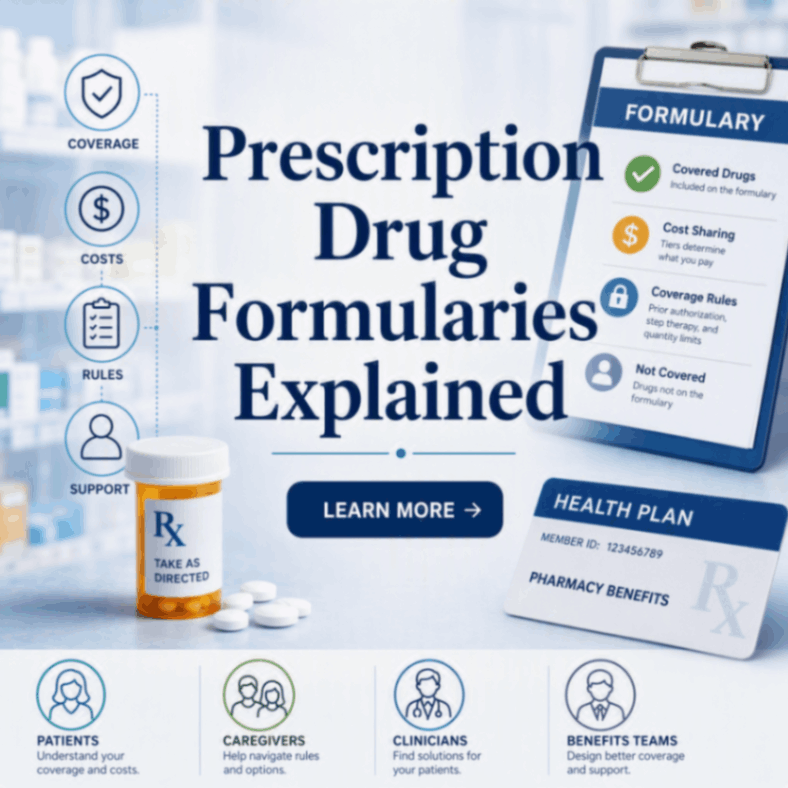
A prescription can be clinically appropriate and still be difficult to obtain at the pharmacy counter. The reason is often the health plan’s formulary—the list that determines which drugs are covered, what patients pay, and which rules apply before coverage begins.
This guide to prescription drug formularies explains how these lists work, where coverage problems arise, and what patients, caregivers, clinicians, and benefits teams can do next.
What a prescription drug formulary is
A formulary is a health plan’s list of covered prescription drugs. Commercial insurers, Medicare plans, Medicaid programs, and pharmacy benefit managers use formularies to organize medications by coverage status and patient cost.
A formulary is not simply a list of “approved” and “not approved” drugs. Formularies can reflect clinical review, negotiations, federal and state requirements, manufacturer rebates, supply conditions, and a plan’s effort to manage pharmacy spending.
A drug can be FDA-approved, widely used by clinicians, and still sit on a higher-cost tier or require additional paperwork under a particular health plan.
For patients, the practical questions are usually straightforward: Is my medication covered? What will it cost? And what must happen before the pharmacy can fill it?
For providers and payers, the stakes include treatment continuity, administrative workload, medication adherence, and total cost of care.
HealthCare.gov also defines a formulary as the list of prescription drugs covered by a prescription drug plan.
How formulary tiers affect out-of-pocket costs
Most formularies place drugs into tiers. Lower tiers generally mean lower copays or coinsurance, while specialty and non-preferred drugs tend to cost more. The labels vary by plan, but a common structure looks like this:
- Tier 1 often includes preferred generic drugs.
- Tier 2 may include preferred brand-name drugs and higher-cost generics.
- Tier 3 commonly includes non-preferred drugs with higher cost sharing.
- Specialty tiers may cover high-cost medications used for complex or chronic conditions, often with coinsurance rather than a flat copay.
Medicare explains that lower-tier drugs generally cost less than higher-tier drugs, although each plan can structure its tiers differently.
The tier does not tell the whole story. A $30 copay and 25% coinsurance can produce very different medical bills, especially for specialty medications.
Deductibles matter too. A drug may appear covered but require the patient to pay more out of pocket until the applicable deductible is met.
Medicare Part D formularies
Medicare Part D plans use formularies and must include most drugs in certain protected classes, including medications used to treat cancer, HIV/AIDS, depression and other mental health conditions, epilepsy, and organ-transplant patients.
That does not mean every drug in a class is covered without restrictions or at the same cost.
The coverage rules that can create delays
A formulary may cover a medication while placing utilization-management requirements around it. These policies are designed to support appropriate use and manage spending, but they can create friction when a patient needs treatment quickly.
Prior authorization
Prior authorization requires the prescriber to show that a drug meets the plan’s coverage criteria before the plan will pay for it. The plan may ask for a diagnosis, treatment history, laboratory results, dosing information, or documentation that other options were ineffective or inappropriate.
Prior authorization is common for expensive specialty medications, newer therapies, and drugs with specific coverage criteria. It also appears in highly visible categories such as GLP-1 medications for diabetes and weight management, where coverage criteria can differ significantly between plans.
A prior authorization request can be approved, denied, or returned for missing information. Patients should not assume that a prescription from their clinician means the medication is automatically ready for pickup.
Medicare provides a useful overview of prior authorization and other drug-plan rules.
Step therapy
Step therapy requires a patient to try one or more plan-preferred drugs before coverage begins for another medication. Plans sometimes call this “fail first.”
For example, a plan may require a patient to use a generic medication before covering a brand-name alternative.
This approach can be reasonable when drugs are clinically interchangeable for a particular patient. It becomes more complicated when a person has already tried the preferred option, experienced side effects, or has a medical reason that the medication is not appropriate.
Those details should be documented in the medical record and included in an exception request when appropriate.
Quantity limits and specialty pharmacy rules
Quantity limits cap the amount of a medication a plan will cover during a set period. They can reflect safety considerations, FDA labeling, or efforts to control waste and spending.
Sometimes the problem can be resolved by correcting the prescription’s day supply or dosage instructions.
Specialty drugs may also need to be filled through a designated specialty pharmacy. That can add coordination, shipping, and storage considerations, particularly for injectable or temperature-sensitive medicines.
Patients should ask how refills, urgent shipments, and clinical support will work before assuming the process is routine.
How to check a formulary before treatment starts
The best time to check coverage is before a prescription is sent, not after a patient has run out of medication.
A plan’s online formulary search tool, member portal, or customer service line can usually confirm the drug’s tier and coverage restrictions. HealthCare.gov recommends checking the insurer’s drug list, reviewing plan materials, or contacting the insurer directly.
Still, a formulary check is a starting point—not necessarily a guarantee of the final pharmacy price.
Look for the exact:
- Drug name
- Strength
- Dosage form
- Route of administration
- Brand or generic version
- Quantity and day supply
A tablet, capsule, extended-release product, injectable, biosimilar, and brand-name product can have different coverage rules.
Patients should also check whether their pharmacy is in network. Even when a medication is on the formulary, using an out-of-network pharmacy can increase the bill or eliminate coverage.
For Medicare beneficiaries, it is particularly important to review the plan’s current drug list and coverage rules because plans can make certain formulary changes during the year under Medicare rules.
When a medication is not covered
A non-covered drug does not always mean the treatment path has ended.
The prescriber may be able to:
- Prescribe a covered therapeutic alternative
- Request prior authorization
- Request a formulary exception
- Request a tiering exception when available
- Appeal a coverage denial
The right option depends on the patient’s diagnosis, previous treatments, clinical risk, and the plan’s coverage criteria.
A formulary exception asks the health plan to cover a drug that is not normally covered or to waive a particular coverage restriction. The request is generally stronger when it explains why covered alternatives would be ineffective, cause adverse effects, or pose a medical risk.
If the plan denies the request, the denial notice should explain the reason and the appeal process.
Keep copies of the formulary entry, prior authorization response, clinical notes, and pharmacy messages. These records can help the prescribing office, insurer, and patient determine whether the problem is a clinical denial, processing error, or network issue.
For urgent situations, ask whether the plan offers an expedited review. Timing matters when treatment interruption could worsen symptoms or create a serious health risk.
Questions to ask at the pharmacy and clinic
Clear questions can prevent weeks of back-and-forth.
Ask:
- Is the medication on my formulary?
- What tier is it on?
- What is my estimated out-of-pocket cost?
- Do I have to meet a deductible first?
- Does it require prior authorization?
- Does step therapy apply?
- Is there a quantity limit?
- Do I have to use a specialty or mail-order pharmacy?
- Is there a covered alternative?
- If coverage is denied, can my doctor request an exception or appeal?
Clinicians and care teams can help by documenting prior therapies, contraindications, side effects, and patient-specific reasons for the chosen drug.
Health systems are also increasingly using electronic prior authorization tools, but technology does not replace a careful review of the plan’s criteria. An electronic check may not capture every benefit change, pharmacy network issue, or rule for a particular dosage form.
For employers and benefits leaders, formulary design is a population-health issue—not only a pharmacy-spend issue.
A restrictive formulary may lower immediate drug spending but increase administrative burden or reduce adherence if patients cannot access clinically appropriate therapy. A more generous formulary may improve access while increasing premiums or plan spending.
The trade-off requires ongoing review of costs, outcomes, appeals, and member experience.
The bottom line
A prescription drug formulary is more than a list of covered medications. It can determine what patients pay, which drugs they can access, and what steps they must complete before coverage begins.
Check the formulary when coverage begins, when a clinician changes therapy, and when the health plan announces changes. Understanding the drug’s tier, restrictions, pharmacy network, and exception process can turn a surprise at the pharmacy counter into a conversation with options.
Thank you, You will be automatically subscribed to the our newsletter.