
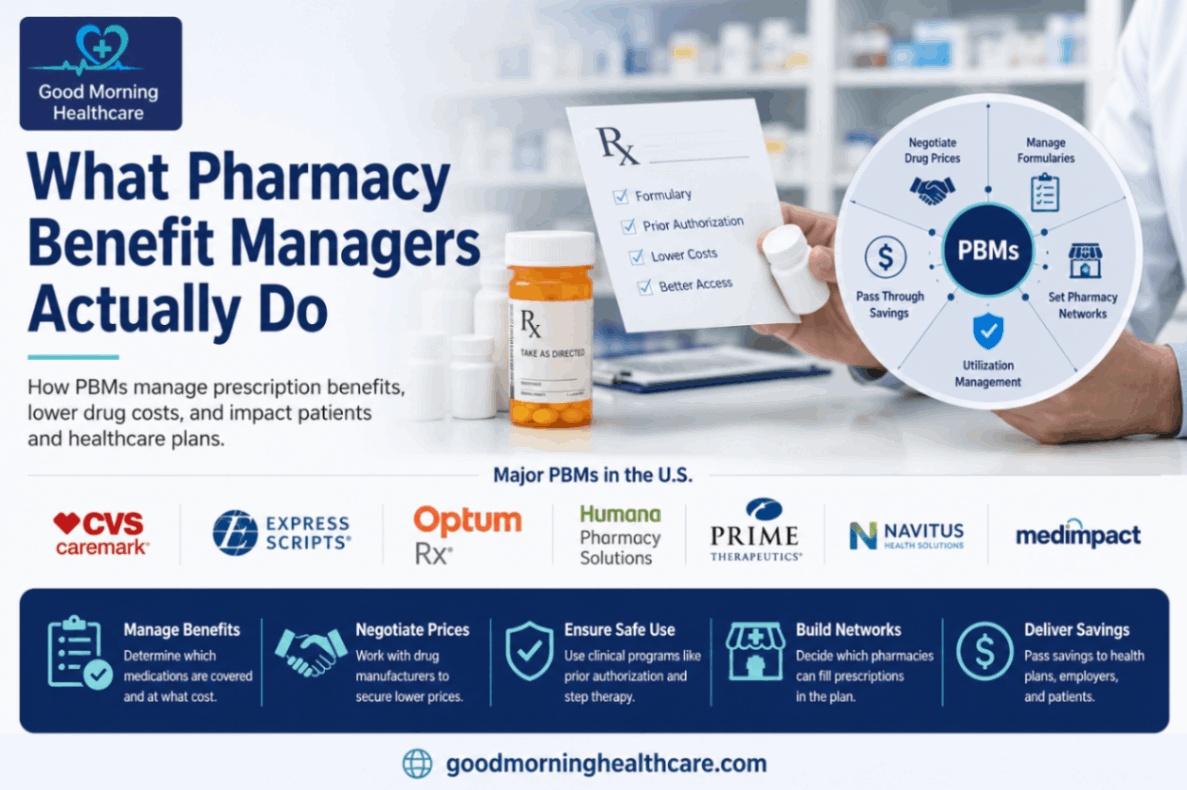
Getting a prescription filled may seem straightforward. Your clinician writes a prescription, the pharmacist dispenses the medication, and you pay your copay. Behind that simple transaction, however, is a complex system that influences which drugs are covered, how much they cost, whether prior authorization is required, and even which pharmacy you can use. At the center of that system are pharmacy benefit managers (PBMs).
Understanding Pharmacy Benefit Managers: Role, Rebates, Formularies, and Drug Pricing
PBMs are companies that administer prescription drug benefits for health insurers, employer-sponsored health plans, unions, and government programs. They began as claims processors, helping plans determine whether a prescription was eligible for coverage and what a patient owed. Their responsibilities now extend much further.
A PBM commonly builds and manages a formulary, the list of drugs a health plan covers. Drugs are often placed into tiers, with lower patient cost-sharing for preferred products and higher cost-sharing for nonpreferred options. PBMs also negotiate with drug manufacturers for rebates or discounts, operate mail-order and specialty pharmacy services, and set reimbursement terms for many retail pharmacies.
This does not mean a PBM independently decides every coverage rule. Employers and insurers can choose benefit designs and may set their own priorities. Still, PBMs supply the infrastructure, contracting leverage, and clinical-utilization programs that make those benefits work at scale. In a market where one specialty drug can cost tens of thousands of dollars per year, those choices carry significant financial weight.
| PBM Function | What It Means for Patients |
|---|---|
| Formulary management | Determines which drugs are covered |
| Drug negotiations | Attempts to reduce medication costs |
| Rebates | Discounts negotiated with manufacturers |
| Prior authorization | Requires approval before some drugs are covered |
| Step therapy | Requires trying lower-cost options first |
| Pharmacy networks | Determines where prescriptions can be filled |
How PBMs Lower Drug Costs — and Why They Are Controversial
The case for PBMs is straightforward: a large purchaser can negotiate more aggressively than an individual employer or health plan. PBMs can seek price concessions from manufacturers in exchange for favorable formulary placement. They can encourage the use of generic drugs and biosimilars, identify possible drug-safety issues, and steer prescriptions toward lower-cost options when clinically appropriate.
Those functions can generate real savings. A formulary that favors effective generics, for example, may reduce a plan’s spending without changing a patient’s health outcome. Utilization management can also prevent duplicate therapies or unsafe combinations. The value of these tools depends on how they are designed and whether exceptions are handled quickly when a patient needs a specific treatment.
The criticism centers on incentives, transparency, and market power. Rebates are usually calculated as a percentage of a drug’s list price. That structure can create concern that a high-list-price drug with a large rebate may be more attractive to a plan than a lower-list-price competitor with a smaller rebate. A health plan may receive savings in aggregate while a patient with coinsurance pays based on the higher list price at the counter.
Another concern is spread pricing. In some arrangements, a PBM may charge a health plan more for a prescription than it reimburses the pharmacy, keeping the difference. The practice is not universal, and contract terms vary, but it has been a focus of state and federal scrutiny. Independent pharmacies have also raised concerns about reimbursement rates, audit practices, and the financial effects of preferred pharmacy networks.
Vertical integration adds another layer. Some large PBMs are affiliated with health insurers and own or are connected to specialty and mail-order pharmacies. Supporters say integration can coordinate care and reduce administrative duplication. Critics argue it can steer patients toward affiliated pharmacies and make it harder to see where revenue is generated across the supply chain. Both can be true in different arrangements, which is why contract details matter more than broad labels.
How PBMs Affect Patients: Formularies, Prior Authorization, and Step Therapy
Patients may never see the phrase “pharmacy benefit manager” on their insurance card, but they routinely encounter PBM-administered policies. Three are especially common: formularies, prior authorization, and step therapy.
A formulary can change during a plan year, depending on the plan’s rules and applicable regulations. If a medication moves to a less favorable tier or is removed from coverage, patients may face a higher bill or need a different prescription. Prior authorization requires the prescriber to show that a drug meets plan criteria before it is covered. Step therapy asks a patient to try one medication, often a lower-cost option, before coverage begins for another.
These rules can be clinically reasonable in some cases. They can also create delays, administrative work for practices, and confusion for patients who have been stable on a medication. The difference often comes down to the condition, the available alternatives, and the speed of the exception process. A person with a chronic condition may reasonably view a coverage change very differently from a plan administrator looking at annual drug-spending trends.
PBM Reform: Regulation, Transparency, and the Future of Drug Pricing
PBMs have become a central policy issue as lawmakers and regulators examine drug pricing across the supply chain. Federal proposals have targeted issues such as rebate transparency, spread pricing, pharmacy reimbursement, and the reporting of PBM business practices. States have also adopted a wide range of laws governing PBM licensing, appeals, pharmacy payment, and patient protections.
One emerging approach is greater use of pass-through models. Under these arrangements, rebates and certain pharmacy payments are passed through to the health plan, while the PBM charges a clearer administrative fee. That can improve visibility, but it does not automatically guarantee lower premiums or lower out-of-pocket costs. Employers still need to understand whether negotiated savings reach the plan, the member at the point of sale, or both.
There is also increased attention to biosimilars, which are highly similar to existing biologic medicines and can offer meaningful competition in categories such as inflammatory disease, diabetes, and cancer care. PBM formulary choices can strongly influence how quickly biosimilars gain adoption. The clinical evidence, a patient’s treatment history, and the benefit design all remain relevant.
Questions Patients and Employers Should Ask About PBMs
For patients, the practical question is usually not who negotiated a rebate. It is whether a needed medicine is affordable and available without an avoidable delay. Before filling a new prescription, check the plan’s formulary, ask whether prior authorization applies, and compare the cost at an in-network pharmacy with mail-order options if the medication is appropriate for longer-term use. If coverage is denied, ask the prescriber’s office about an exception, appeal, or covered alternative.
For employers and other plan sponsors, the questions are more contractual. They should understand rebate guarantees, whether rebates are retained or passed through, how specialty drugs are managed, how pharmacies are reimbursed, and what data the PBM will provide. Lowest administrative fee is not necessarily the lowest total cost. Nor is the highest rebate necessarily the best value if it relies on high list prices or creates difficult patient access rules.
Pharmacy benefit managers are not a side issue in drug pricing. They are one of the places where clinical decisions, insurance design, and corporate incentives meet. For anyone trying to make sense of a prescription bill or a health plan’s drug costs, asking how the benefit is managed is often the most useful next step.
Frequently Asked Questions About PBMs
What does PBM stand for?
PBM stands for pharmacy benefit manager. PBMs manage prescription drug benefits for health plans, employers, government programs, and other organizations.
Do PBMs increase prescription drug costs?
The answer depends on the specific contract structure and market arrangement. Supporters argue PBMs reduce costs through negotiation and utilization management, while critics argue certain practices may increase costs or reduce transparency.
Are PBMs owned by insurance companies?
Some large PBMs are affiliated with health insurers, while others operate independently.
Do patients choose their PBM?
Usually no. Employers, insurers, and government programs select PBM services as part of their pharmacy benefit design.
How do PBMs make money?
PBMs may generate revenue through administrative fees, negotiated arrangements with manufacturers, pharmacy services, and other contractual agreements depending on their business model.
Good article from historically pharmacy benefit managers perspective on negotiating drug prices and processing pharmacy claims. Increasingly, technology is expanding their role into personalized healthcare navigation, predictive medication management, and automated administrative workflows. Members may soon interact with an advanced health concierge that helps explain benefits, coordinates care, identifies lower-cost treatment options, and proactively supports medication adherence. For employers and health plans, these innovations have the potential to improve member satisfaction, reduce administrative costs, and deliver better health outcomes while helping control pharmacy spending.