
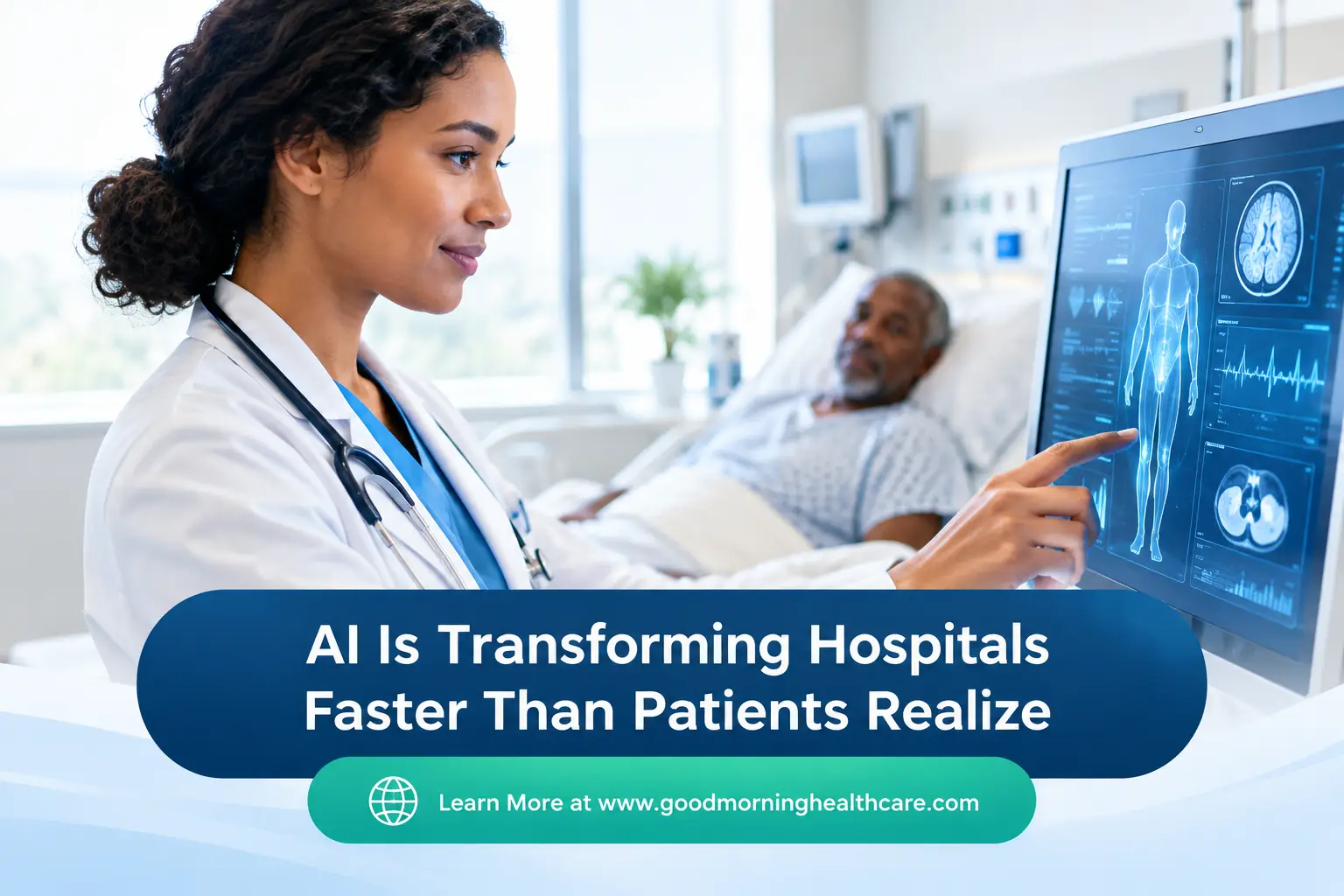
A patient may never see the artificial intelligence working behind the scenes during a hospital visit.
AI may help route a message to the right care team, flag a possible abnormality on a medical scan, predict when a hospital bed will become available, or turn a doctor’s spoken observations into a clinical note.
AI is transforming hospitals faster than many patients realize. Much of that change is happening behind the scenes—in workflows that have traditionally been slow, manual, and labor-intensive.
The U.S. Food and Drug Administration (FDA) maintains a growing list of AI-enabled medical devices authorized for marketing in the United States, illustrating how artificial intelligence is moving from research into real-world healthcare.
But AI does not necessarily mean that an algorithm is taking over medical care. In many applications, AI is designed to support clinicians rather than replace them.
As hospitals deal with staffing shortages, rising costs, crowded emergency departments, and growing administrative workloads, even modest improvements in efficiency can affect how quickly patients receive care.
How Are Hospitals Using AI?
AI in hospitals is being used across several areas, including:
- Medical imaging and diagnostic support
- Clinical documentation
- Patient messaging and scheduling
- Hospital bed and staffing management
- Early-warning systems for clinical deterioration
- Revenue-cycle and administrative tasks
- Care coordination and population health management
The technology varies considerably. Some systems analyze medical images, while others process text, predict patterns, or automate repetitive administrative work.
The important distinction is that AI is not one technology with one purpose. Its risks and benefits depend heavily on what the system is designed to do and how clinicians use its output.
For a broader look at how AI fits into the expanding digital-health landscape, see our guide to digital health and how it is changing healthcare.
AI in Medical Imaging Can Help Clinicians Spot Urgent Problems
One of the most established areas of AI in healthcare involves medical imaging.
AI-enabled software can analyze X-rays, CT scans, MRIs, mammograms, and other medical images and identify patterns that may require closer attention.
Depending on the system, AI may help flag potential findings such as:
- Stroke
- Lung nodules
- Fractures
- Internal bleeding
- Certain tumors or other abnormalities
The technology does not necessarily make the final diagnosis. Instead, it can provide another signal for a radiologist or other clinician to consider.
That distinction matters.
If imaging software identifies a possible brain bleed or large-vessel blockage, for example, it may help bring attention to a potentially urgent case while a specialist reviews the study.
The potential benefit is not that AI is infallible. It is that AI can help clinical teams prioritize information in situations where time matters.
The FDA explains that AI and machine learning technologies are increasingly being incorporated into medical devices and can be used for applications including image processing, early disease detection, diagnosis, prognosis, and risk assessment. Learn more from the FDA about AI and medical devices.
AI Can Help Hospitals Manage Beds, Staffing and Patient Flow
Some of the most important applications of AI may never be visible to patients.
Hospitals must constantly balance emergency-department arrivals, admissions, discharges, available beds, operating-room schedules, staffing levels, and patient transfers.
Predictive analytics and machine-learning systems can help hospitals forecast demand and identify patterns that may affect patient flow.
For patients, the result could potentially look very ordinary:
- A shorter wait for an inpatient bed
- Better coordination of a transfer
- Faster discharge processing
- More efficient scheduling
- Fewer avoidable bottlenecks
But AI cannot solve every hospital capacity problem.
A hospital with too few nurses, physicians, beds, or other essential resources cannot simply automate its way out of a staffing shortage.
That is particularly important as healthcare workforce pressures continue to affect access and patient care. See our related article on how the U.S. doctor shortage could affect patients.
AI may help hospitals make better use of existing resources, but it does not eliminate the need for people.
Generative AI Is Changing Clinical Documentation
One of the most visible areas of generative AI adoption in healthcare is clinical documentation.
Doctors and other healthcare professionals can spend substantial amounts of time documenting patient encounters in electronic health records.
Ambient documentation systems can listen to a clinical conversation, generate a draft note, and allow the clinician to review, correct, and approve the final version.
The potential benefit is straightforward:
Less time typing could mean more time communicating with patients.
It may also reduce some of the after-hours documentation that contributes to administrative workload and clinician burnout.
But automated documentation requires human review.
A clinical conversation can contain medical terminology, incomplete sentences, family discussions, medication names, and subtle contextual information. An AI system can misunderstand or omit important details.
The clinician remains responsible for reviewing the final documentation.
For patients, that means it is still important to review visit summaries, medication lists, diagnoses, and instructions and ask questions when something appears incorrect.
AI Can Support Clinicians, But It Does Not Replace Clinical Judgment
The strongest healthcare AI applications are generally designed to augment human decision-making rather than eliminate it.
A nurse deciding whether a patient’s condition has changed, a physician explaining treatment options, and a pharmacist identifying a potential medication problem all require context and professional judgment.
AI can organize information, recognize patterns, generate summaries, and surface potential concerns.
But the clinical team must determine what those findings mean for the individual patient.
The FDA’s Good Machine Learning Practice principles emphasize the development of safe, effective, and high-quality AI and machine-learning medical devices across their product life cycle.
That is an important concept for patients:
An AI system should not be judged only by how well it performs in a demonstration. Hospitals also need to understand how it performs in real-world clinical settings.
AI May Provide Earlier Warnings—but False Alerts Are a Risk
Hospitals are also exploring predictive models that identify patients who may be at increased risk for complications or clinical deterioration.
Depending on the application, these systems may look for patterns associated with:
- Sepsis
- Falls
- Pressure injuries
- Readmission
- Clinical deterioration
- Other complications
The goal is to give clinicians an earlier opportunity to assess the patient.
But predictive systems can create a problem of their own: too many alerts.
If clinicians receive large numbers of warnings that turn out not to be clinically important, alert fatigue can develop. Staff may become less responsive to future alerts.
AI models can also perform differently when used with patient populations or clinical workflows that differ from the data used to develop or validate the system.
That is why hospitals need ongoing performance monitoring.
The FDA’s guidance on predetermined change control plans for machine-learning-enabled medical devices emphasizes the importance of monitoring deployed models and managing risks associated with retraining and changes in performance.
Bias and Health Equity Matter
AI systems learn from data.
If the underlying data do not adequately represent the patients who will ultimately use the system, performance may not be equal across different populations.
That makes questions about bias and health equity particularly important.
Hospitals should evaluate whether an AI system performs appropriately across relevant patient populations and should have processes for identifying and addressing unexpected differences in performance.
The FDA’s transparency principles for machine-learning-enabled medical devices emphasize transparency about a system’s intended use, performance, risks, and limitations. The FDA also highlights the importance of understanding the performance of the human-AI team.
The World Health Organization similarly emphasizes ethics, governance, transparency, human rights, and accountability in the development and use of AI for health. Read the WHO guidance on ethics and governance of artificial intelligence for health.
What Should Patients Ask About AI in Hospitals?
Patients do not need to become data scientists to ask reasonable questions about artificial intelligence in healthcare.
If AI is being used in a meaningful part of your care, you can ask:
Is AI being used in my care?
For example, is it being used to interpret an image, draft documentation, prioritize a message, or support a clinical decision?
Who reviews the AI’s output?
Knowing whether a physician, nurse, radiologist, pharmacist, or another qualified professional reviews the result can provide important context.
What information does the system use?
Some AI systems may rely on medical records, images, clinical notes, conversations, or other health information.
How is my health information protected?
Privacy and security considerations can differ depending on the technology, organization, and type of information involved.
What happens if the AI is wrong?
A well-designed workflow should have a way for clinicians to identify, correct, and learn from errors.
The FDA’s transparency guidance specifically notes that patients and healthcare professionals are among the audiences that may need information about an AI-enabled medical device, including its intended use, performance, risks, and limitations.
AI involvement does not automatically mean that a patient’s care is experimental. Many AI applications are intended to support routine clinical and administrative tasks.
The more important question is whether the hospital has appropriate safeguards around the technology.
The Business Case for Hospital AI Is Real—but So Are the Trade-Offs
Hospitals are under significant financial and operational pressure.
AI can potentially help with:
- Administrative documentation
- Scheduling
- Revenue-cycle operations
- Coding
- Patient communication
- Care coordination
- Resource planning
- Identifying operational inefficiencies
But automation can create new problems if it makes healthcare harder to understand or harder to navigate.
For example, an automated system that routes a patient to the wrong department may save a few minutes for the organization while creating a much bigger problem for the patient.
The same issue can arise with health insurers and other parts of the healthcare system. AI may help identify gaps in care or streamline administrative processes, but patients still need understandable explanations and meaningful ways to reach a person when something goes wrong.
Our article on how health insurers can rebuild trust explores why transparency and accountability matter as healthcare organizations adopt new technologies.
AI Regulation Is Evolving
AI in healthcare is developing faster than many traditional regulatory frameworks.
The FDA maintains an AI-enabled medical device list that identifies AI-enabled medical devices authorized for marketing in the United States. The FDA notes that the list is not comprehensive but is intended to provide transparency about the current landscape.
The regulatory environment is also evolving rapidly.
In August 2026, the FDA released a discussion paper on considerations for regulating generative-AI-enabled medical devices. The paper addresses issues including risk assessment, premarket evaluation, postmarket monitoring, and the challenges posed by rapidly evolving generative AI systems.
The FDA is seeking public feedback on the discussion paper through October 19, 2026.
That means the rules surrounding AI in healthcare will continue to evolve.
For patients, the practical takeaway is that an AI label alone does not tell you whether a particular tool is useful, safe, or appropriate for a particular clinical situation.
The intended use, evidence, oversight, and safeguards matter.
What Does the Future of AI in Hospitals Look Like?
The near-term future is likely to be less dramatic than some headlines suggest—and potentially more consequential.
Rather than one all-knowing hospital AI, expect many specialized systems operating across:
- Medical imaging
- Clinical documentation
- Scheduling
- Patient communication
- Hospital operations
- Care management
- Billing and administration
- Clinical decision support
These systems may become increasingly embedded in ordinary healthcare workflows.
Patients may not even realize that AI was involved.
That could ultimately be useful if the technology reduces administrative friction, helps clinicians process information, and improves coordination without taking accountability away from healthcare professionals.
But the basics still matter.
Hospitals need accurate data, trained staff, appropriate governance, privacy protections, ongoing monitoring, and a willingness to change or discontinue systems that do not perform as expected.
The World Health Organization’s work on artificial intelligence for health similarly emphasizes responsible AI development, ethics, governance, and public trust.
The Bottom Line: AI Should Make Healthcare Better, Not Simply More Automated
AI is transforming hospitals, but the most important question is not how much AI a hospital uses. It is whether the technology actually improves care.
The most useful hospital AI may be the technology patients barely notice:
A scan reviewed sooner.
A clinician spending less time typing.
A patient message reaching the right team.
A hospital bed becoming available more efficiently.
A potential problem being flagged earlier.
But AI should remain a tool within a larger healthcare system—not a replacement for clinical judgment, human communication, or accountability.
For patients, the best approach is simple: ask questions, review your medical information, understand when AI is involved, and expect qualified healthcare professionals to remain accountable for decisions about your care.
The most worthwhile hospital AI will not make healthcare feel more automated.
It will give the people providing care more time, better information, and better tools to care for patients.
Reviewed by Nancy Kumar, Chief Editor
Thank you, You will be automatically subscribed to the our newsletter.