
You may already be using digital health without realizing it.
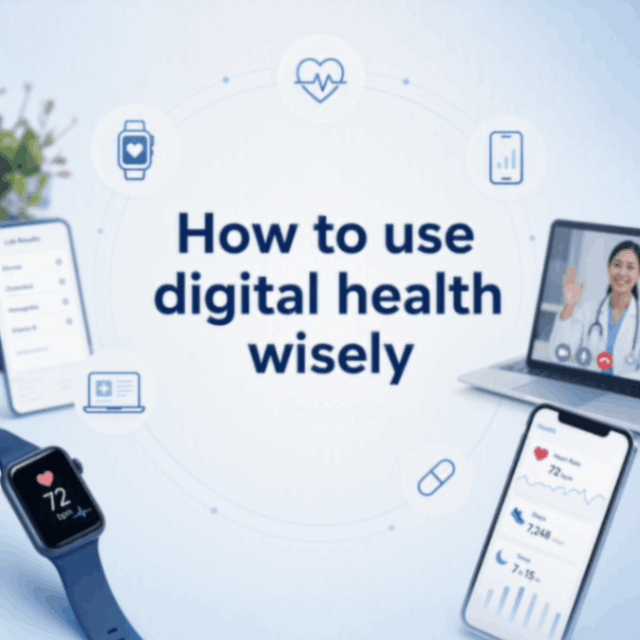
A smartwatch that monitors your heart rate. A glucose monitor that sends readings to your phone. A video appointment with your doctor. An online portal showing your latest blood test. An app that reminds you to take your medication.
All of them can be considered digital health.
But here’s the surprising part: digital health is much broader than telehealth—and not every digital health tool necessarily makes healthcare better.
The U.S. Food and Drug Administration (FDA) describes digital health as a broad field that includes mobile health, health information technology, wearable devices, telehealth, personalized medicine, software and artificial intelligence. Some technologies are general wellness products, while others may qualify as medical devices. (FDA: What Is Digital Health?)
That raises a more useful question for consumers:
Which digital health tools can actually improve your healthcare, and how can you use them without creating more confusion, cost or risk?
What exactly is digital health?
There is no single gadget or app that defines digital health.
Instead, digital health is an umbrella term for technology that uses software, computing, connectivity or sensors to support health or healthcare.
That includes technologies used by patients, doctors, hospitals, insurers, employers and researchers.
Digital health can include:
| Digital health technology | What it can do |
|---|---|
| Telehealth | Connect you with a healthcare professional by video or phone |
| Patient portals | Give you access to test results, messages, appointments and health records |
| Wearables | Track information such as heart rate, activity, sleep or other measurements |
| Remote patient monitoring | Send health information from your home to a healthcare team |
| Health apps | Help track medications, symptoms, nutrition, exercise or other health information |
| Electronic prescriptions | Allow prescriptions to be sent electronically to pharmacies |
| Artificial intelligence | Analyze information, recognize patterns and assist with certain healthcare tasks |
| Clinical decision support | Give healthcare professionals information that can support medical decisions |
| Digital therapeutics and medical software | Use software as part of treatment or disease management |
The FDA notes that digital health technologies range from general wellness applications to technologies that may be regulated as medical devices. (FDA Digital Health Technologies)
So your fitness tracker and a medical software system can both fall under the broad digital-health umbrella—but they shouldn’t automatically be treated as equivalent.
You may be using digital health every day
Digital health isn’t necessarily something you download from an app store.
Consider a typical healthcare journey.
You schedule an appointment online.
You have a virtual visit.
Your doctor orders blood work electronically.
You receive your results through a patient portal.
Your pharmacy receives your prescription electronically.
You use a smartwatch or home blood-pressure monitor between appointments.
Your healthcare team reviews some of that information during your next visit.
That’s digital health.
The technology is becoming less visible because it is increasingly built into the normal healthcare experience.
Where digital health can actually improve healthcare
The best digital health technologies don’t simply add technology.
They solve a problem.
1. It can make healthcare easier to access
Telehealth can eliminate some of the time, transportation and scheduling barriers associated with an office visit.
According to Telehealth.HHS.gov, telehealth can allow patients to communicate with providers through video or telephone, send secure messages and share information such as blood-pressure readings. HHS also notes that telehealth can save travel time and sometimes provide faster access to care.
Telehealth can be particularly useful for:
- Routine follow-up visits
- Medication management
- Behavioral health
- Some skin conditions
- Minor illnesses
- Chronic disease management
- Reviewing certain test results
- Follow-up after treatment
But telehealth isn’t appropriate for everything. Some conditions require a physical examination, imaging, laboratory testing or an in-person procedure.
The goal shouldn’t be to replace in-person care. It should be to use the right type of care for the right situation.
2. It can bring monitoring into your home
Traditionally, much of healthcare has been episodic.
You visit a doctor’s office, get a measurement and then go home.
Digital health can provide a different model.
A patient with high blood pressure, for example, may take readings at home and share them with a healthcare professional. Someone with diabetes may use a connected glucose monitor to track changes throughout the day.
This can give clinicians information about what is happening between appointments, rather than relying entirely on what happens during a 15- or 30-minute visit.
But there’s an important catch:
Data isn’t the same thing as care.
A remote-monitoring program works best when someone is actually reviewing the information and there is a clear plan for what happens when readings change.
3. It can make healthcare easier to navigate
Some of the most valuable digital health tools aren’t particularly exciting.
A patient portal that lets you see your laboratory results may not sound revolutionary.
Neither does an online prescription refill.
But these tools can remove friction from a healthcare system that often requires patients to coordinate doctors, specialists, pharmacies, laboratories and insurance companies.
Digital tools can help patients:
- Schedule appointments
- Request prescription refills
- View test results
- Message healthcare professionals
- Review medical information
- Receive reminders
- Track appointments
Sometimes the best technology is the technology that simply makes something difficult easier.
But more health data isn’t always better
Digital health creates an enormous amount of information.
Your smartwatch might track your heart rate and activity.
Your phone might record your steps.
An app might record your symptoms, food or medications.
A glucose monitor can provide readings throughout the day.
A connected blood-pressure monitor can create a history of measurements.
That’s potentially valuable—but it can also create information overload.
Imagine receiving an abnormal reading from a wearable but having no idea whether it is medically important.
The result may be anxiety rather than better health.
Clinicians can experience the same problem. A healthcare professional who receives thousands of data points from patients needs the time and tools to determine which information actually requires attention.
The important question isn’t:
“How much data does this device collect?”
It’s:
“What can someone do with the information?”
A useful digital health tool should ideally connect information to an action.
Does it help identify a problem earlier?
Does it improve medication adherence?
Does it help a doctor make a better decision?
Does it prevent an unnecessary trip to the emergency room?
Does it help a patient understand what to do next?
If not, the additional data may have limited value.
How to tell if a digital health product is actually useful
Digital health companies often promote impressive numbers:
1 million users.
Millions of downloads.
High engagement.
Artificial intelligence-powered.
But popularity isn’t the same as clinical effectiveness.
Before relying on a digital health product for an important health decision, look for evidence.
Ask:
- Who tested it?
- How many people participated?
- What outcome improved?
- Was there a comparison group?
- How long did the study last?
- Was the research published independently?
- Does the evidence apply to people like you?
This is particularly important when a product makes medical claims.
The FDA explains that some software functions may fall under the definition of a medical device depending on their intended use. (FDA: Software Functions and Medical Devices)
Bottom line: Don’t confuse a polished app with proven healthcare.
What about AI in digital health?
Artificial intelligence is rapidly becoming part of digital health.
AI can potentially help with:
- Summarizing medical information
- Analyzing medical images
- Supporting documentation
- Identifying patterns in health data
- Routing patient messages
- Supporting clinical decisions
- Answering some administrative questions
The FDA says artificial intelligence and machine learning are increasingly being incorporated into medical devices and digital health technologies. (FDA Digital Health and AI Glossary)
But AI has a fundamental limitation:
It can be wrong while sounding very confident.
That matters in healthcare.
A mistaken restaurant recommendation is annoying.
A mistaken medical recommendation can be dangerous.
That’s why AI should generally be viewed as a tool to support healthcare professionals and patients—not an automatic replacement for clinical judgment.
You can read more about this issue in our article, Can We Trust Healthcare Advice From ChatGPT?.
Wearables: useful health tool or just another gadget?
Wearables are probably the most visible form of consumer digital health.
Smartwatches and other devices can track things such as:
- Heart rate
- Physical activity
- Sleep
- Exercise
- Some heart-rhythm information
- Other health-related measurements
Some can be genuinely useful.
But consumers should understand the difference between measuring something and diagnosing something.
A wearable may detect a change in a measurement. That doesn’t necessarily mean you have a disease.
If your device produces a concerning result, the appropriate next step may be to discuss it with a healthcare professional rather than trying to diagnose yourself from the device.
Our guide to wearable ECG and heart monitoring explains more about what these devices can—and cannot—tell you.
Your health data is valuable. Who gets it?
This is one of the most overlooked issues in digital health.
Many people assume that all health information receives the same privacy protections.
It doesn’t.
Information held by a healthcare provider may be subject to HIPAA and other requirements. But a consumer health app or connected device may operate under a different regulatory framework.
The Federal Trade Commission has specifically updated its Health Breach Notification Rule to clarify its application to health apps and similar technologies that aren’t covered by HIPAA. (FTC: Health Breach Notification Rule)
Before giving a health app access to your information, ask:
What does this app collect?
Why does it need the information?
Who can receive it?
Is it shared with other companies?
Can I delete my information?
What happens if the company suffers a data breach?
The FTC notes that health apps and connected devices can collect highly sensitive health information and that privacy and security responsibilities can vary depending on the technology and organization involved. (FTC Health Privacy)
In other words, “It’s a health app” does not automatically mean “my health information is completely private.”
How to use digital health wisely
For consumers, the goal shouldn’t be to use as much digital health technology as possible.
Instead, use technology where it solves a real problem.
A simple five-question test
Before adopting a digital health tool, ask:
1. What problem does it solve?
If you can’t answer this, you may not need it.
2. Does it have evidence behind it?
Look beyond advertising and user reviews.
3. Who is responsible for acting on the information?
Data without follow-up may not improve your care.
4. What happens to my health information?
Read the privacy policy before giving an app access to sensitive information.
5. Does it complement my healthcare team?
The best digital tools should make communication and decision-making easier—not create another disconnected system.
The future of digital health isn’t just more technology
The next phase of digital health may be less about creating another standalone app and more about connecting the pieces of healthcare.
Think about the journey of a person managing a chronic condition:
Doctor → prescription → pharmacy → insurance → home monitoring → patient portal → follow-up care
Ideally, these pieces shouldn’t operate as separate islands.
The most useful digital health technologies will make that journey easier to navigate.
They will help patients access care, help clinicians make better decisions, reduce unnecessary administrative work and protect sensitive health information.
And perhaps most importantly, they will know when technology isn’t the answer.
The bottom line
Digital health is much bigger than telehealth.
It includes the devices, software, data systems and digital services increasingly woven into everyday healthcare.
Used properly, digital health can make care more convenient, improve access, provide useful information between appointments and help patients become more engaged in their own health.
But technology isn’t automatically better healthcare.
The best digital health tool isn’t necessarily the newest or most sophisticated.
It’s the one that solves a real healthcare problem, has evidence behind it, protects your information and helps you—or your healthcare professional—make a better decision.
Great article and an excellent compilation of what truly fits under the broad umbrella of digital health—definitely a must-read.
What’s most important now is moving beyond technology itself to how we connect data, clinical care, access, and economics to create measurable value for patients and the healthcare system.