
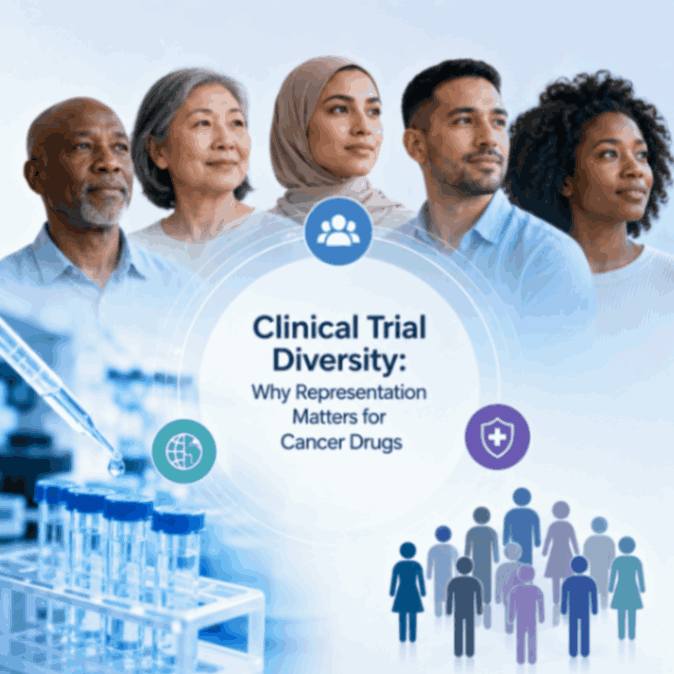
A cancer drug can produce impressive results in a clinical trial and still leave important questions unanswered when it reaches the broader population. Who participates in clinical trials matters—because the people enrolled in research are the people whose experiences help determine how confidently doctors, patients, regulators and payors can evaluate a treatment.
This is why clinical trial diversity has become more than a research or fairness issue. It is increasingly a question of evidence, patient safety and healthcare quality.
Age, sex, race and ethnicity, geography, health status, disability, income, language and other factors can influence how patients experience disease and treatment. When important populations are missing from a clinical trial, researchers may have less information about how a therapy performs in the people who will ultimately use it.
What Is Clinical Trial Diversity?
Clinical trial diversity means enrolling participants who reasonably reflect the population affected by the condition being studied.
That does not mean every trial must perfectly mirror the U.S. population. Rare diseases, pediatric conditions and highly specialized therapies naturally create recruitment limitations.
The more important question is whether the study population is appropriate for the patients who are expected to receive the treatment.
The FDA’s Drug Trials Snapshots program provides demographic information about participants in pivotal trials supporting new drug approvals, including sex, race, ethnicity, age and U.S. participation.
Clinical Trial Diversity: Key Statistics
| Measure | What the data show |
|---|---|
| Novel drugs approved by FDA in 2024 | 50 |
| Participants in pivotal trials supporting those approvals | ~31,000 |
| Cancer drug programs analyzed by FDA in 2024 | 15 |
| Female participation in cancer programs | 47% |
| Cancer trial participants age 65+ | 36% |
| U.S. participation in cancer programs | 86% |
| Asian participation in cancer drug programs | 44% average |
| Example: Tevimbra trial | 80% Asian; 0% Black |
| Example: Imdelltra trial | 41% Asian; 0% Black |
| Example: Itovebi trial | 38% Asian; 1% Black |
Source: FDA 2024 Drug Trials Snapshots Summary Report. Percentages are reported by the FDA for the relevant drug programs and should not be interpreted as a measure of disease prevalence or ideal representation.
The numbers illustrate an important point: diversity is not simply about whether different groups appear somewhere in a trial. The proportion and characteristics of participants can vary substantially from one therapy and disease to another.
Why Diverse Clinical Trials Produce Better Evidence
Clinical trial diversity is often discussed in terms of fairness. But it is also about scientific quality and patient safety.
Age, sex, genetics, kidney and liver function, other medical conditions and medications can influence how a person responds to treatment. Social and economic circumstances can matter as well.
For example, a therapy requiring frequent visits to a specialty center may be relatively easy to use for a patient living near an academic medical center but much harder for someone in a rural community.
When important groups are absent from a trial, researchers and clinicians may have to extrapolate results. That does not necessarily mean a treatment will not work for an underrepresented population. It means there may be less direct evidence about its effectiveness, safety or practical use.
The FDA’s guidance on enhancing clinical trial diversity specifically addresses eligibility criteria, enrollment practices and trial design as ways sponsors can improve participation.
The Enrollment Problem Starts Before Recruitment
It is easy to describe low clinical trial participation as a problem of patient awareness or trust. Trust is important, but many barriers are operational.
Clinical trials may be concentrated at academic medical centers far from the communities most affected by a disease. Eligibility requirements may exclude people with common chronic conditions or medications. Study visits can require transportation, child care, time away from work and repeated laboratory testing.
Language can be another barrier. Consent information that is difficult to understand or unavailable in a participant’s preferred language can make informed participation more difficult.
Technology can help—but it can also create new barriers. Video visits, electronic consent, patient portals and wearable devices may reduce travel for some participants while excluding people who lack broadband access, compatible devices or digital confidence.
What Better Clinical Trial Design Looks Like
Improving clinical trial diversity needs to begin before recruitment starts.
Sponsors and investigators should ask:
- Who is affected by this disease?
- Where do those patients receive care?
- Are trial sites located in communities where potential participants live?
- Which eligibility requirements are scientifically necessary?
- What transportation, scheduling or financial barriers could prevent participation?
- Can information and consent materials be provided in accessible language?
Community-based recruitment can help. Partnerships with community physicians, safety-net providers, patient advocacy organizations and community health workers can make clinical research more accessible.
Eligibility criteria also deserve careful examination. Researchers should exclude people when there is a legitimate scientific or safety reason—not simply because they make the study population more complicated.
The National Cancer Institute emphasizes expanding access to cancer clinical trials and involving participants who are representative of different racial, ethnic and socioeconomic backgrounds.
Practical support matters, too. Transportation assistance, flexible appointment times, mobile research teams and reimbursement for reasonable participation expenses can remove barriers without lowering scientific standards.
FDA and NIH Are Raising Expectations
The push for more representative clinical research is not new.
The NIH inclusion policy requires women and members of racial and/or ethnic minority groups to be included in NIH-funded clinical research unless there is a compelling scientific or ethical reason for exclusion. NIH also expects appropriate analysis of differences among groups in certain Phase 3 trials.
The FDA has also moved toward more formal diversity planning. Under the Food and Drug Omnibus Reform Act of 2022, Congress directed FDA to require Diversity Action Plans for certain clinical studies. FDA published draft guidance in June 2024 describing how those plans should address enrollment of underrepresented populations.
The message is increasingly clear: diversity should be considered during study design, site selection and recruitment—not added at the end when enrollment numbers fall short.
What Patients Should Look For in a Clinical Trial
Patients do not need to be statisticians to evaluate a study.
Consider asking:
Who participated?
Were participants similar in age, sex, racial and ethnic background and health status to people who typically develop the condition?
Who was excluded?
Did eligibility criteria eliminate people with common medical conditions or medications?
Were subgroup results reported?
Did researchers examine whether benefits or side effects differed across relevant populations?
Does the study resemble real-world care?
A treatment tested at highly specialized centers with intensive monitoring may be useful, but its real-world implementation could look very different.
The FDA’s Drug Trials Snapshots can be a useful starting point for seeing who participated in trials supporting recently approved drugs.
Clinical Trial Diversity Is Part of the Evidence
Clinical trial diversity should not be viewed as a box to check after a study has already been designed. It is part of determining how much confidence we can place in the evidence itself.
A treatment’s headline result tells only part of the story. The participants behind that result tell another.
For patients, clinicians, regulators and payors, one question is increasingly important:
Does the evidence reflect the people who will actually use the treatment?
The stronger the answer, the more useful clinical research becomes—not only for advancing new cancer treatments, but for building a healthcare system in which scientific progress can benefit the broadest possible patient population.
Thank you, You will be automatically subscribed to the our newsletter.