
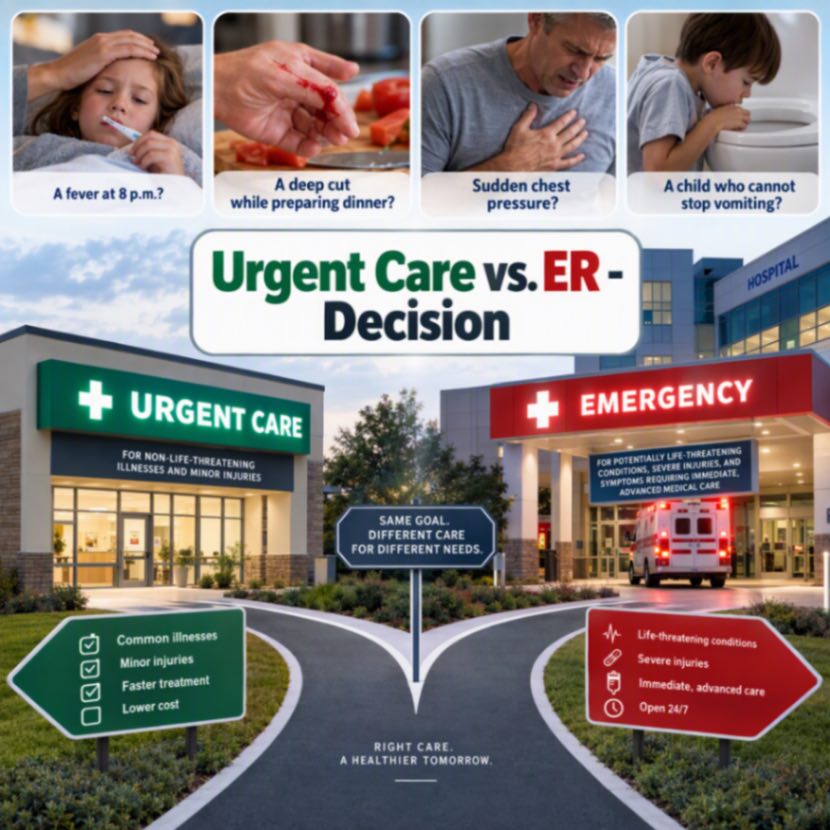
A fever at 8 p.m., a deep cut while preparing dinner, sudden chest pressure, or a child who cannot stop vomiting can leave you facing an important decision: Should you go to urgent care or the emergency room?
Knowing when to choose urgent care vs. the ER can help you get the right treatment faster, avoid unnecessary expenses, and make informed decisions about your health. But when symptoms appear suddenly, the difference is not always obvious.
The most important factor is not convenience or cost. It is the severity of the condition and the level of medical care you may need.
The general rule: Urgent care is appropriate for many non-life-threatening illnesses and minor injuries. The emergency room is designed to evaluate and treat potentially life-threatening conditions, severe injuries, and symptoms that may require immediate, advanced medical intervention.
If you or someone else may be experiencing a medical emergency, call 911. Do not delay emergency care to read this article or compare treatment options.
Urgent Care vs. ER: What’s the Difference?
Urgent care centers and hospital emergency rooms both provide prompt medical attention, but they serve different purposes.
Urgent care is designed for illnesses and injuries that need timely treatment but are unlikely to require hospital-level emergency services. Emergency rooms, by contrast, are equipped to manage critical conditions, perform advanced diagnostic testing, stabilize patients, and arrange hospital admission when necessary.
Here is a quick comparison.
| Feature | Urgent Care | Emergency Room (ER) |
|---|---|---|
| Best for | Minor illnesses and injuries | Potentially life-threatening conditions and serious injuries |
| Typical availability | Often evenings and weekends; hours vary | Open 24 hours a day, 7 days a week |
| Common services | Basic lab tests, X-rays, stitches, treatment for common infections | Advanced imaging, extensive laboratory testing, emergency procedures, specialist consultations |
| Serious breathing problems | Usually not appropriate | Appropriate; call 911 for severe symptoms |
| Suspected heart attack or stroke | Not appropriate | Call 911 |
| Hospital admission | Generally cannot admit patients | Can evaluate patients and arrange admission |
| Typical cost | Usually lower | Usually higher, depending on insurance and treatment |
Services vary by facility. Some urgent care centers offer pediatric services, X-rays, and basic laboratory testing, while others have more limited capabilities.
The bottom line: If a condition could threaten life, limb, or major organ function, choose emergency care. If symptoms are uncomfortable but stable and do not suggest an emergency, urgent care may be the better option.
When Should You Go to Urgent Care?
Urgent care is often the right choice when you need medical attention promptly but your symptoms are not severe enough to suggest a medical emergency.
These centers can be particularly helpful when your primary care physician is unavailable, especially during evenings, weekends, or holidays.
Common conditions treated at urgent care
Minor illnesses
- Sore throat or suspected strep throat
- Earaches and sinus infections
- Urinary tract infection symptoms
- Pink eye
- Mild respiratory infections
- Cough without significant breathing difficulty
- Mild rashes without signs of a severe allergic reaction
Minor injuries
- Small cuts that may require stitches
- Minor burns
- Sprains and strains
- Possible uncomplicated fractures
- Minor sports injuries
Other routine medical needs
- Certain vaccinations
- School, sports, or employment physicals
- Basic diagnostic testing
- Mild dehydration when the person can drink fluids and has no concerning symptoms
For example, an otherwise healthy adult with a sore throat, a low-grade fever, and no difficulty breathing or swallowing may be appropriately evaluated at urgent care.
Similarly, someone who twists an ankle while exercising may benefit from an urgent care visit if the injury is not severe and there are no signs of a more serious problem.
However, an injury that appears minor can sometimes involve a more significant fracture or internal damage. Severe pain, deformity, numbness, uncontrolled bleeding, or loss of function may require emergency evaluation.
What if urgent care cannot treat your condition?
Urgent care centers have limits. They may not have the equipment, specialists, or monitoring capabilities needed to evaluate certain conditions.
If a clinician suspects a serious problem, you may be referred to a hospital emergency department.
That does not mean urgent care was the wrong decision. It means the medical team recognized that you needed a higher level of care.
Before visiting, check the center’s hours and available services, particularly if you need pediatric care, an X-ray, or treatment for a specific injury.
When Should You Go to the ER Instead of Urgent Care?
Go to the emergency room for potentially serious symptoms that may require immediate testing, treatment, or monitoring.
Call 911 for symptoms that suggest an immediate, life-threatening emergency. Do not drive yourself if you are experiencing symptoms that could worsen during the trip.
1. Chest pain or pressure
New or unexplained chest pain, pressure, tightness, or discomfort can signal a heart attack or another serious condition.
Other warning signs include:
- Shortness of breath
- Sweating or nausea
- Pain spreading to the arm, back, shoulder, neck, or jaw
- Sudden dizziness or faintness
Heart attacks do not always cause the classic crushing chest pain often portrayed in movies. Women, older adults, and people with diabetes may experience less typical symptoms, including unusual fatigue, nausea, breathlessness, or indigestion-like discomfort.
If you suspect a heart attack, call 911 rather than driving to urgent care or the hospital yourself.
2. Signs of a stroke
A stroke requires immediate medical evaluation because treatment may be time-sensitive.
Watch for sudden:
- Facial drooping
- Weakness or numbness, especially on one side of the body
- Difficulty speaking or understanding speech
- Vision changes
- Loss of balance or coordination
- Severe headache without an obvious explanation
Remember the warning signs using FAST:
- F — Face: Does one side of the face droop?
- A — Arms: Does one arm drift downward or feel weak?
- S — Speech: Is speech slurred or difficult to understand?
- T — Time: Call 911 immediately.
Do not wait to see whether the symptoms improve. Even if they disappear, urgent emergency evaluation is necessary.
3. Severe breathing problems or a serious allergic reaction
Seek emergency care for significant difficulty breathing, severe wheezing, blue or gray lips, or a feeling that you cannot get enough air.
Swelling of the tongue or throat, particularly with breathing difficulty, can indicate a life-threatening allergic reaction called anaphylaxis.
Call 911. If the person has a prescribed epinephrine auto-injector for anaphylaxis, use it according to their emergency action plan while awaiting help.
4. Severe bleeding or serious injuries
An emergency department is generally the appropriate setting for:
- Bleeding that does not stop with firm, direct pressure
- Deep wounds or injuries involving major blood loss
- Major falls, vehicle collisions, or other significant trauma
- Serious head injuries
- Suspected fractures with major deformity or impaired circulation
- Injuries involving possible damage to tendons, nerves, or internal organs
For severe bleeding, call 911 and apply firm, direct pressure to the wound while following the dispatcher’s instructions.
A small, clean cut with controlled bleeding may be suitable for urgent care. A deep wound with uncontrolled bleeding is a different situation entirely.
5. Severe abdominal pain or persistent vomiting
Severe or rapidly worsening abdominal pain may indicate appendicitis, an intestinal obstruction, internal bleeding, or another condition requiring urgent investigation.
Emergency evaluation is particularly important when abdominal pain occurs with:
- Persistent vomiting or inability to keep fluids down
- Blood in vomit or stool
- A swollen or rigid abdomen
- Fainting or confusion
- Severe pain during pregnancy
Repeated vomiting can also cause significant dehydration, especially in young children and older adults. If the person becomes difficult to wake, faints, or develops other severe symptoms, seek emergency care.
6. Seizures, loss of consciousness, or sudden confusion
Call 911 for a first-time seizure, a seizure lasting five minutes or longer, repeated seizures without recovery, difficulty breathing after a seizure, or a seizure accompanied by serious injury.
Sudden confusion, loss of consciousness, or difficulty waking someone can also signal a serious medical problem.
A person who has fainted and has chest pain, breathing difficulty, significant bleeding, or persistent confusion needs emergency evaluation.
7. Mental health emergencies
A mental health crisis can require emergency care when someone is at immediate risk of suicide, serious self-harm, or harming another person.
If there is immediate danger, call 911. In the United States, people experiencing a mental health crisis can also call or text 988 for support through the 988 Suicide & Crisis Lifeline.
When possible, remain with the person and help maintain a safe environment while connecting with appropriate emergency support.
This list is not exhaustive. When symptoms are severe, sudden, rapidly worsening, or potentially life-threatening, do not rely on a checklist to rule out an emergency.
Urgent Care vs. ER for Fever: What About Children and Older Adults?
Fever is one of the most common reasons people seek medical attention, but the right setting depends on the patient’s age, symptoms, and medical history.
For an otherwise healthy adult with a mild fever who is alert, breathing comfortably, and drinking fluids, urgent care may be appropriate if medical evaluation is needed.
However, some patients need more urgent assessment.
Infants younger than 3 months
A temperature of 100.4°F (38°C) or higher in an infant younger than 3 months requires prompt medical evaluation. Contact a healthcare professional immediately and seek emergency evaluation as directed. Do not delay care while trying to arrange a routine appointment.
Young children
For children, behavior and hydration can be as important as the temperature itself.
Seek emergency care for warning signs such as:
- Difficulty breathing
- Blue or gray lips
- Severe lethargy or difficulty waking
- A seizure
- A stiff neck with concerning symptoms
- Signs of severe dehydration
Very few wet diapers, a dry mouth, or an absence of tears may indicate dehydration and warrant prompt medical assessment, particularly when accompanied by unusual sleepiness or an inability to drink.
Older adults and people with chronic conditions
Older adults and people with weakened immune systems may develop serious infections without a high fever.
Patients receiving chemotherapy, taking medications that suppress the immune system, or living with complex chronic conditions should follow their clinician’s guidance about fever and other new symptoms.
The important lesson: The same symptom can have different levels of risk for different people. Age, underlying conditions, medications, and the severity of symptoms all matter when choosing between urgent care and the ER.
Is Urgent Care Cheaper Than the Emergency Room?
In many cases, yes. Urgent care generally costs less than an emergency department visit for comparable, non-emergency problems.
However, your actual out-of-pocket cost depends on your health insurance plan, deductible, copay, coinsurance, the services provided, and whether the facility and clinicians are in network.
An emergency department visit may involve separate facility and professional charges, along with additional costs for imaging, laboratory testing, or treatment.
Urgent care may be a more economical choice for a minor infection, a simple laceration, or an uncomplicated sprain.
But cost should never be the deciding factor when a medical emergency is possible.
In the United States, the federal Emergency Medical Treatment and Labor Act (EMTALA) generally requires Medicare-participating hospital emergency departments to provide an appropriate medical screening examination and stabilizing treatment for emergency medical conditions, regardless of insurance status or ability to pay.
This does not mean emergency care is free. Patients may still receive substantial medical bills.
For non-emergency symptoms, consider checking your insurance plan’s urgent care benefits or contacting your primary care office. Some health plans also offer nurse advice lines and telehealth services that can help you determine the appropriate next step.
These options are useful when symptoms are mild and stable. They should not delay emergency treatment when warning signs are present.
What If You Are Not Sure Whether to Go to Urgent Care or the ER?
Uncertainty is common. Symptoms do not always fit neatly into categories, and it can be difficult to determine how serious a condition is without medical assessment.
A practical approach is to consider three questions:
1. Could the problem threaten breathing, circulation, consciousness, or brain function?
Examples include chest pressure, severe breathing difficulty, stroke symptoms, fainting with concerning symptoms, or uncontrolled bleeding. These may require emergency services.
2. Did the symptoms begin suddenly, become severe quickly, or follow a major injury?
Sudden severe headaches, rapidly worsening abdominal pain, serious falls, and significant trauma can signal conditions that need emergency evaluation.
3. Could the person need advanced testing, emergency treatment, or hospital-level monitoring?
If a serious condition is reasonably possible, the ER is generally the safer choice. If symptoms are mild, stable, and consistent with a routine illness or minor injury, urgent care may be appropriate.
These questions are decision aids, not diagnostic tests. A person can have a serious condition without displaying every classic warning sign.
If you remain unsure, contact a healthcare professional or nurse advice line when doing so will not delay necessary treatment. For potentially life-threatening symptoms, call 911.
Can Telehealth or Your Primary Care Doctor Be an Alternative?
Urgent care and the ER are not the only options for getting medical attention.
For mild, stable symptoms, a primary care clinician or telehealth service may be able to assess your concerns and recommend treatment.
Examples include:
- Questions about mild cold symptoms
- Medication-related questions
- Follow-up for an existing health condition
- Some uncomplicated skin conditions
- Guidance about whether an in-person visit is necessary
Telehealth cannot provide every examination, diagnostic test, or procedure. A clinician may recommend an in-person evaluation if the diagnosis is uncertain or symptoms suggest a more serious problem.
For ongoing health concerns, your primary care physician can also help coordinate care and reduce unnecessary visits to urgent care or the emergency department.
However, telehealth should not be used to rule out a suspected heart attack, stroke, severe allergic reaction, or other time-sensitive emergency.
The Bottom Line: Choose the Right Level of Care
Understanding urgent care vs. the ER can help you make better healthcare decisions for yourself and your family.
Urgent care is a useful option for many common illnesses and minor injuries that need prompt attention but are not life-threatening. Emergency departments provide the advanced testing, treatment, and monitoring needed for serious or potentially life-threatening conditions.
The most important distinction is the risk to the patient—not the time of day, the distance to the nearest facility, or the expected cost.
When symptoms are mild and stable, urgent care, primary care, or telehealth may be appropriate. When symptoms are severe, sudden, rapidly worsening, or potentially life-threatening, seek emergency help.
When in doubt about a potentially life-threatening condition, err on the side of safety and call 911.
At GoodMorningHealthcare.com, our goal is to help you make informed healthcare decisions with practical, understandable information. Knowing where to go for care is one small step that can make a meaningful difference when it matters most.
This article is for general educational purposes only and is not a substitute for professional medical advice, diagnosis, or treatment. If you think you may be experiencing a medical emergency, call 911.
Thank you, You will be automatically subscribed to the our newsletter.