
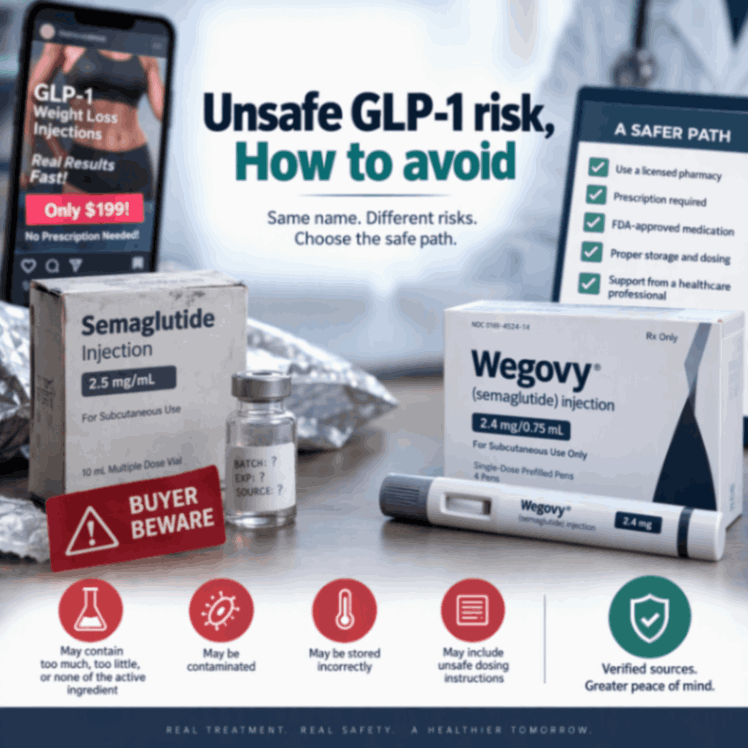
A weight-loss injection advertised on social media may arrive in professional-looking packaging, carry a familiar medication name, and cost far less than a pharmacy quote. But appearances and attractive prices do not guarantee safety.
Counterfeit and unsafe GLP-1 drugs are an increasing concern as demand for medications such as semaglutide and tirzepatide continues to reshape obesity and diabetes treatment. The U.S. Food and Drug Administration (FDA) has warned about counterfeit Ozempic, illegally marketed products, and dosing errors involving compounded semaglutide.
For consumers, the challenge is knowing which products are legitimate and which could put their health at risk.
The danger goes beyond buying medication without a prescription. An unverified product may contain the wrong ingredient, an incorrect concentration, or no active ingredient at all. It may also be contaminated, improperly stored, or supplied with confusing instructions that lead to a dosing error.
For patients, healthcare providers, employers, health plans, and digital health companies, the message is clear: access to treatment matters, but it must not come at the expense of medication safety.
Why Are Unsafe GLP-1 Weight-Loss Drugs Becoming a Concern?
GLP-1 medications have transformed the treatment landscape for obesity and type 2 diabetes. Depending on the medication and its approved indication, these treatments can improve blood sugar control and support weight management for appropriate patients.
However, access remains complicated. Patients may face high out-of-pocket costs, insurance exclusions, prior authorization requirements, or difficulty finding an affordable treatment option.
These challenges create opportunities for sellers offering cheaper alternatives outside established healthcare and pharmacy systems.
Some websites advertise injectable medications without requiring an appropriate prescription. Others market products labeled as peptides or for research use while using weight-loss claims and promotional images clearly aimed at consumers.
Social media advertisements may direct buyers to private messaging accounts, unfamiliar websites, or sellers who ship injectable products directly to the customer.
The FDA has specifically warned consumers about unapproved GLP-1 drugs marketed for weight loss, including fraudulent products and concerns involving compounded medications.
Why Professional Packaging Does Not Guarantee a Legitimate Drug
Counterfeiters may copy medication names, labels, packaging, lot numbers, and other identifying details.
A seller might also claim that a product is FDA registered, pharmacy grade, or manufactured in a certified facility. These claims do not establish that a specific drug is FDA approved, authentic, or legally marketed.
The FDA explains that counterfeit medicines can contain incorrect ingredients, harmful substances, or inappropriate amounts of an active ingredient.
Consumers should not attempt to establish authenticity from photographs or packaging alone. If a product’s legitimacy is uncertain, contact the dispensing pharmacy and prescribing clinician before using it.
What Are the Health Risks of Counterfeit or Unsafe GLP-1 Injections?
The risks depend on what the product contains, how it was manufactured and stored, the amount administered, and the patient’s health.
Several concerns deserve particular attention.
1. Incorrect Ingredients or Drug Concentrations
A counterfeit injection may not contain the medication identified on its label. It could contain an incorrect concentration, an unexpected ingredient, or a substance that has not been evaluated for safe human use.
This uncertainty makes it difficult for a clinician to predict the drug’s effects or determine the appropriate response if a patient develops symptoms.
2. Contamination and Infection
Injectable medications must be manufactured, handled, and packaged under appropriate quality and sterility controls.
An unsafe product may be contaminated or supplied with needles and syringes whose safety cannot be verified. Injection-site redness, swelling, pain, or other unusual symptoms may signal a problem requiring medical evaluation.
3. Dosing Errors and Accidental Overdose
GLP-1 medications are generally introduced using a prescribed dosing schedule, with gradual dose increases when appropriate.
Some compounded injectable products are supplied in multidose vials rather than the prefilled pens used for certain FDA-approved medications. Different concentrations, unfamiliar syringes, and confusing instructions can increase the risk of medication errors.
The FDA has reported cases in which patients receiving compounded semaglutide accidentally administered substantially more medication than intended. Some patients required medical attention or hospitalization.
Read the FDA’s warning about dosing errors associated with compounded injectable semaglutide to understand why incorrect measurements and confusing instructions can be dangerous.
Confusion between milligrams, milliliters, and syringe units can be especially dangerous when patients attempt to calculate their own doses.
Never estimate an injection dose based on an online video, another person’s instructions, or a syringe used with a different product. If the prescribed dose or measurement is unclear, contact the prescribing clinician or dispensing pharmacist before injecting the medication.
4. Serious Side Effects and Complications
GLP-1 medications can cause nausea, vomiting, diarrhea, constipation, and other gastrointestinal symptoms, even when obtained through legitimate channels.
Excessive dosing or an unsafe product can introduce additional uncertainty and increase the risk of harm.
Potential complications include severe vomiting, dehydration, kidney injury associated with dehydration, gallbladder problems, and pancreatitis. Low blood sugar is also a concern, particularly when GLP-1 treatment is combined with certain other diabetes medications.
These risks do not mean that appropriately prescribed GLP-1 medications are inherently unsafe. They underscore the importance of using a verified medication supply and following a clinician-directed treatment plan.
5. Delayed Diagnosis and Interrupted Treatment
Another risk is that patients may stop an established treatment, conceal their use of an unverified injection, or delay seeking help because they are worried about being judged.
This can make it harder for clinicians to identify the cause of symptoms and manage other medications safely.
Patients should tell their healthcare team what they have taken, including products purchased online or through social media. Accurate information helps clinicians assess potential drug interactions, dosing errors, and complications.
Counterfeit GLP-1 Drugs vs. Compounded Medications: What Is the Difference?
Not every compounded medication is counterfeit or illegal. Understanding the distinction is essential for making informed healthcare decisions.
FDA-Approved GLP-1 Medications
FDA-approved medications have undergone regulatory review for their approved uses, including evaluation of safety, effectiveness, and manufacturing quality.
Examples include semaglutide products marketed under brand names such as Ozempic and Wegovy, and tirzepatide products marketed as Mounjaro and Zepbound. Their approved indications differ, so the appropriate medication depends on the patient’s medical needs and prescribing guidance.
An FDA-approved medication should be obtained through a legitimate, authorized supply chain.
Compounded GLP-1 Medications
Compounding involves preparing a medication for a particular patient when the applicable legal and clinical requirements are met.
Compounded medications are not FDA approved in the same way as branded products. The FDA does not review each compounded drug for safety, effectiveness, and quality before it is marketed.
Compounding may be appropriate in certain circumstances, but it should not be assumed that a compounded product is equivalent to an FDA-approved medication simply because its label references the same drug ingredient.
The FDA has also warned about compounded products that are fraudulently labeled, including products whose labels identify pharmacies that did not actually prepare them.
Patients should understand why a compounded medication is being prescribed, who is preparing it, how it differs from an approved product, and what safeguards are in place.
For more information, review the FDA’s guidance on compounding drugs using semaglutide and other GLP-1 ingredients.
Why Current Compounding Rules Matter
The legal requirements governing compounded GLP-1 medications have changed as drug shortages have been reassessed and regulatory policies have evolved.
Patients should not assume that a product is lawful simply because a telehealth company or pharmacy offers it.
The FDA has published updates on its policies for compounded GLP-1 drugs. Because regulatory requirements can change, patients and healthcare organizations should consult current FDA guidance rather than relying on outdated online information.
The safest approach is to ask the prescribing clinician or pharmacist to explain the product’s regulatory status, why it is being prescribed, and whether an FDA-approved alternative is appropriate.
How to Recognize a Potentially Unsafe Online GLP-1 Seller
No single warning sign proves that a medication is counterfeit. However, several red flags should prompt caution.
Be especially careful if a seller:
- Offers prescription injections without requiring a valid prescription or appropriate clinical evaluation.
- Advertises unusually low prices without clearly identifying the dispensing pharmacy.
- Sells injectable products through social media messages, private groups, or unfamiliar online marketplaces.
- Uses claims such as guaranteed weight loss, no side effects, or results without medical supervision.
- Provides vague information about the medication’s ingredients, concentration, manufacturer, or source.
- Cannot provide a verifiable U.S. pharmacy address or a way to contact a licensed pharmacist.
- Uses pressure tactics, cryptocurrency, or unusual person-to-person payment arrangements.
- Supplies medication with unclear dosing instructions or packaging that appears inconsistent with what the dispensing pharmacy describes.
A legitimate online pharmacy should require a prescription when one is required, provide accessible contact information, and be appropriately licensed.
However, even a professional-looking website and a prescription requirement do not independently establish that every product being sold is authentic.
How to Verify an Online Pharmacy
Before ordering a prescription medication online, take these precautions.
1. Verify the pharmacy’s license. Check the relevant state board of pharmacy’s official licensing database.
2. Confirm the pharmacy’s identity. Look for a physical address, working telephone number, and access to a licensed pharmacist.
3. Confirm the prescription pathway. A legitimate process should involve an appropriate clinical evaluation and a valid prescription when required.
4. Ask where the medication comes from. The prescribing clinician or dispensing pharmacist should be able to explain the product, its source, and how it will be dispensed.
5. Be cautious about online claims. A seller’s statements about FDA registration, certifications, or product authenticity should not replace independent verification.
The FDA provides additional practical advice in its guide to buying medicines safely from an online pharmacy.
What Should You Do If You Have Already Used a Questionable GLP-1 Product?
If you have injected a product that may be counterfeit, improperly compounded, or otherwise unsafe, take the concern seriously.
Do not take another dose until you have obtained appropriate medical guidance.
Keep the packaging, vial, syringe, receipt, and any dosing instructions. These details may help healthcare professionals identify the product and assess your exposure.
Contact your prescribing clinician or a pharmacist promptly, even if you feel well, particularly if you do not know exactly what the product contained or how much you injected.
When Should You Seek Emergency Medical Care?
Seek immediate medical attention for symptoms such as:
- Severe or persistent vomiting
- Severe or persistent abdominal pain
- Fainting or significant confusion
- Difficulty breathing
- Swelling of the tongue or throat
- Signs of a severe allergic reaction
- Symptoms of dangerously low blood sugar, particularly if you also use insulin or certain other diabetes medications
Call 911 for life-threatening symptoms.
If you have diabetes, do not independently discontinue or change your other diabetes medications without medical guidance. Tell your healthcare team about the questionable product so they can advise you on the safest next steps.
How to Report a Suspected Counterfeit or Unsafe Medication
Reporting suspected counterfeit drugs and medication-related adverse events can help regulators identify potential risks.
In the United States, patients and healthcare professionals can report relevant concerns through the FDA’s MedWatch program. Suspected illegal drug sales can also be reported through the FDA’s consumer complaint and reporting channels.
Preserve available product information and provide accurate details about where the medication was purchased, what the packaging states, and any symptoms experienced.
Do not send the product to an unfamiliar address or return it to a seller if doing so could expose you or others to additional risk. Ask a healthcare professional or the appropriate regulatory agency how to handle it.
Why Affordable GLP-1 Access Matters
For many patients, the search for an unsafe or questionable alternative begins with a legitimate problem: the prescribed treatment is expensive or difficult to obtain.
Insurance coverage may be limited by the drug’s indication, the patient’s plan design, prior authorization rules, or benefit exclusions. Patients seeking treatment for obesity may face different coverage requirements from those seeking treatment for type 2 diabetes.
These barriers can make an attractive online offer difficult to ignore.
However, the apparent savings may come with substantial medical and financial risks if the product is counterfeit, improperly prepared, or incorrectly dosed.
Before pursuing an unverified option, ask your healthcare team about legitimate alternatives. Depending on your circumstances, these might include an FDA-approved medication covered by your plan, manufacturer assistance or savings programs for which you qualify, a different treatment, or additional support for nutrition, physical activity, and weight management.
Our related article, Are Affordable Health Plans Really Affordable?, explores the broader challenges consumers face when evaluating healthcare costs.
You can also read Can TrumpRx Really Cut Your Medication Costs? Here’s the Breakdown for more context on prescription drug affordability.
Affordability is an important part of healthcare access. But a lower advertised price does not necessarily mean a better or safer treatment option.
What Healthcare Organizations and Employers Should Know
The growth of questionable GLP-1 products is not just a consumer issue. It also presents challenges for healthcare organizations, pharmacy benefit managers, employers, health plans, and digital health companies.
As organizations develop weight-management benefits and medication access strategies, they should consider three priorities.
First, make legitimate treatment pathways easier to understand. Patients should know which products are FDA approved, what their insurance covers, and whom to contact when cost or availability becomes a barrier.
Second, establish clear prescribing and dispensing safeguards. Telehealth programs should use appropriate clinical evaluations, transparent prescribing practices, pharmacy verification, and clear processes for addressing adverse events.
Third, communicate without blurring important distinctions. Marketing and member education should not imply that counterfeit products, research-use substances, compounded medications, and FDA-approved drugs are interchangeable.
A good medication access strategy should combine affordability, clinical appropriateness, transparent information, and ongoing patient support.
The Bottom Line: A Safer GLP-1 Treatment Starts With a Verified Medication Supply
GLP-1 medications can be valuable tools in the treatment of obesity and type 2 diabetes when prescribed appropriately. But growing consumer demand has also created opportunities for counterfeit products, misleading online sellers, and unsafe medication practices.
A familiar drug name, professional packaging, or low price cannot establish that an injection is authentic or safe.
Patients should obtain prescription medications through legitimate healthcare and pharmacy channels, verify unfamiliar sellers, and consult a qualified healthcare professional before using a product whose identity or dosing instructions are uncertain.
If you have already used a questionable injection, seek medical guidance promptly and do not conceal the product’s source from your healthcare team.
The goal should not simply be access to a weight-loss medication. It should be access to the right treatment, from a verified source, with appropriate clinical oversight and follow-up.
At GoodMorningHealthcare.com, we believe informed patients are better equipped to navigate healthcare choices. Understanding the difference between legitimate treatment options and unsafe shortcuts is an important step toward protecting your health.
This article is for educational purposes only and is not a substitute for professional medical advice, diagnosis, or treatment. Consult a qualified healthcare professional about your individual treatment options. For suspected medication poisoning or an overdose, contact Poison Control in the United States at 1-800-222-1222; call 911 for a life-threatening emergency.
Thank you, You will be automatically subscribed to the our newsletter.