
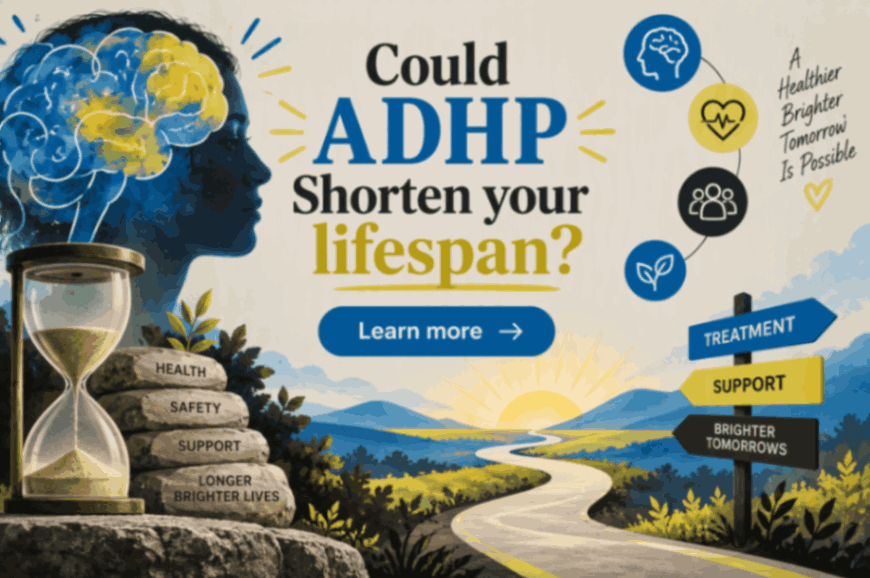
Could attention-deficit/hyperactivity disorder (ADHD) affect how long someone lives? Research suggests that adults diagnosed with ADHD may face a higher risk of premature death. However, these findings do not mean that an individual with ADHD will necessarily live a shorter life.
A major UK study published in The British Journal of Psychiatry in 2025 estimated that adults diagnosed with ADHD had shorter life expectancy than comparable adults without a recorded diagnosis. The findings highlight the importance of understanding ADHD as more than an attention or behavioral condition. They also raise questions about preventable health risks, access to treatment, and long-term healthcare support.
What Did the ADHD Life Expectancy Study Find?
Researchers analyzed UK primary care records covering millions of people, including approximately 30,000 adults diagnosed with ADHD.
The study estimated that life expectancy was approximately 6.8 years shorter for men and 8.6 years shorter for womenwith diagnosed ADHD compared with matched adults without a recorded diagnosis.
These figures are population-level estimates, not predictions for individuals. The study was observational and cannot establish that ADHD itself directly causes early death.
The researchers identified differences in physical and mental health that may help explain the findings. Other factors, including socioeconomic circumstances, access to healthcare, and coexisting conditions, may also contribute.
Read the original research in The British Journal of Psychiatry or the summary from University College London.
Why Can ADHD Affect Health Beyond Attention and Focus?
ADHD can affect attention, impulse control, organization, and daily routines. For some people, these challenges may influence health and safety.
Accidental injuries and impulsivity: Difficulty pausing before acting may contribute to risky situations, including unsafe driving. Practical safety strategies and appropriate treatment can help address individual risks.
Managing chronic conditions: Remembering appointments, taking medications consistently, and arranging prescription refills can be difficult for some people with ADHD. These challenges may complicate the management of conditions such as diabetes or high blood pressure.
Mental health concerns: ADHD can coexist with depression, anxiety, sleep problems, and substance use disorders. These conditions can create additional health challenges and may require coordinated treatment.
Social and economic pressures: Financial difficulties, barriers to healthcare, and disrupted employment may make preventive care harder to maintain for some individuals.
Not everyone with ADHD experiences these challenges. Understanding a person’s specific needs is more useful than assuming the diagnosis determines their health outcomes.
The National Institute of Mental Health’s ADHD guide provides additional information about symptoms, diagnosis, and treatment.
Can ADHD Treatment Reduce the Risk of Early Death?
Treatment can help many people manage ADHD symptoms and improve daily functioning. Depending on the individual, care may include medication, behavioral therapy, psychotherapy, and practical support with organization and routines.
However, the 2025 life-expectancy study did not establish whether ADHD treatment directly increases lifespan. More research is needed to understand how treatment influences long-term mortality.
Medication decisions should be individualized, considering medical history, other medications, side effects, and personal needs. The CDC’s ADHD treatment guidance explains treatment approaches, particularly for children and adolescents.
The goal is to help people manage symptoms, improve quality of life, and address relevant health risks.
What Can People With ADHD Do to Protect Their Health?
Although the research is concerning, practical steps can support better health outcomes.
- Maintain regular medical care. Routine appointments can help identify health concerns and keep preventive screenings up to date. See our guide to cancer screening and which tests make sense.
- Simplify medication routines. Calendar alerts, pharmacy reminders, and automatic refills can help reduce missed doses.
- Prioritize sleep and physical activity. Consistent routines can support overall health and may make daily responsibilities easier to manage.
- Address mental health concerns. Depression, anxiety, and substance use should be discussed with a qualified healthcare professional.
- Build systems, not blame. Shared calendars, written instructions, and appointment reminders can help people manage healthcare more consistently.
For families and caregivers, offering practical support without judgment can make a meaningful difference.
What This Means for Healthcare Providers
The findings also highlight opportunities to improve healthcare delivery. ADHD care should not operate separately from primary care, mental health services, and preventive medicine.
Better coordination, simpler medication processes, accessible treatment, and appropriate screening for coexisting conditions may help address gaps in care.
For healthcare organizations and health plans, designing services around patients’ real-life needs is an important part of supporting long-term health.
The Bottom Line
Research suggests that adults diagnosed with ADHD may have shorter average life expectancy than adults without a recorded diagnosis. However, these estimates do not predict an individual’s future, and the research does not prove that ADHD itself directly causes premature death.
The findings reinforce an important message: ADHD deserves comprehensive care that considers physical health, mental health, safety, and access to treatment.
ADHD is not a life expectancy sentence. Appropriate treatment, preventive care, and practical support can help people manage their health and live fuller lives.
Medical disclaimer: This article is for educational purposes only and is not a substitute for professional medical advice, diagnosis, or treatment.
Thank you, You will be automatically subscribed to the our newsletter.