
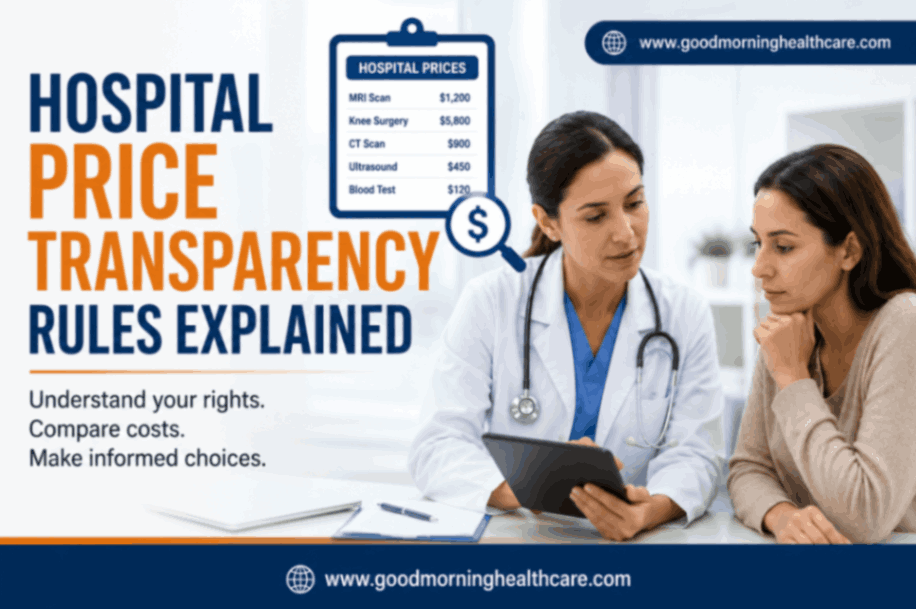
Hospital price transparency rules require most U.S. hospitals to publish their prices online, giving patients greater access to healthcare pricing than ever before. But a published price is not always the amount you’ll actually pay. Insurance coverage, deductibles, physician fees, and where care is provided all affect your final bill. Understanding how these rules work can help patients ask better questions and avoid unexpected healthcare costs.
What hospital price transparency rules require
Since January 1, 2021, most U.S. hospitals have been required by the Centers for Medicare & Medicaid Services (CMS) to make their standard charges available to the public. The requirement generally applies to hospitals operating in the United States, including many rural, specialty, and hospital outpatient facilities, with limited exceptions.
Hospitals must make this information available in two forms. First, they must publish a machine-readable file that can be downloaded and analyzed. This is the large, data-heavy file used most often by researchers, employers, payors, journalists, and technology vendors.
Second, hospitals must provide consumer-friendly pricing information for shoppable services – care that can typically be scheduled in advance.
The standard charges hospitals report can include:
- Gross charges, or the hospital’s full list price before discounts.
- Discounted cash prices for people paying without insurance or choosing self-pay.
- Payer-specific negotiated charges for individual insurance plans.
- The de-identified minimum and maximum negotiated charges across payors.
- Estimated allowed amounts for services billed under Medicare fee-for-service when required data are available.
What patients can learn from a hospital estimate
For a planned service, a hospital’s estimator can be a practical starting point. Search for the service using the clinical term and common language. If the tool asks for an insurer and plan, enter the information carefully. A plan’s network may vary by product, even when the insurer’s name is the same.
Then compare the hospital estimate with the explanation from your insurer. The hospital can tell you its expected charge and whether it has your plan’s contract. Your insurer can help explain deductible status, coinsurance, copayments, prior authorization requirements, and whether the facility is in network.
A strong pre-service question is not simply, “What does this cost?” It is, “Can you provide a written good-faith estimate or patient responsibility estimate for the service, including facility and professional charges that are known at this time?” That wording encourages a more complete discussion.
The biggest gaps in published hospital prices
The most common misunderstanding is treating a posted hospital price as a personal quote. It is not necessarily one. Price transparency files report standard charges, while a patient’s bill reflects the specifics of care delivered and the terms of that person’s coverage.
Emergency care is another clear limitation. Patients should not delay emergency treatment to price-shop. The right care setting is the priority. Federal emergency care obligations and insurance protections apply in certain situations, but the financial details may need to be sorted out afterward.
Complex care also resists simple pricing. A planned delivery, cancer treatment, joint replacement, or hospital admission can change as clinicians respond to complications or new findings.
Provider bills can create another surprise. The hospital’s file may cover the facility charge, while the surgeon, anesthesiologist, radiologist, pathologist, or emergency physician bills separately. Ask whether the estimate includes professional services and whether each clinician is in network. If the answer is unclear, request the names or practice groups expected to bill.
How to use hospital pricing information without getting misled
Use transparency tools as a comparison tool, not a final financial promise. Start with the specific service your clinician ordered, and ask for the relevant billing code if one is available. Check whether the hospital, outpatient center, and physicians involved are in network. Then ask your insurer for an estimate based on your remaining deductible and out-of-pocket maximum.
If you are comparing two facilities, make sure the estimates include the same components. One facility may show only a technical charge, while another includes both technical and professional services. Lower is not always comparable.
Patients should also ask about financial assistance, charity care, prompt-pay discounts, payment plans, and whether an ambulatory surgery center or independent imaging center is clinically appropriate. These options will not fit every condition or every insurance network, but they can materially change the cost of planned care.
Hospital price transparency has made healthcare pricing more accessible, but understanding your expected out-of-pocket costs still requires information from both your hospital and your insurance plan. Before any scheduled procedure, compare estimates, confirm network participation, ask about physician fees, and request a written cost estimate whenever possible. A few questions before treatment can help reduce unexpected medical bills later.
Key Takeaways
- Most U.S. hospitals must publish standard charges online.
- Posted prices are not personalized cost estimates.
- Insurance benefits often determine your final out-of-pocket cost.
- Compare hospital estimates with your insurer’s estimate.
- Ask for a written Good Faith Estimate before scheduled care whenever possible.
Thank you, You will be automatically subscribed to the our newsletter.