
A brightly colored sports drink, candy, cereal, or snack cake can look like a small grocery-store choice. But the FDA ban on food dyes has become a larger public-health and policy question: How much evidence should be required before widely used food additives are removed, and how quickly can the food supply change?
The short answer is that the Food and Drug Administration has not issued one blanket ban covering every artificial color. Instead, the agency has revoked or moved to revoke certain color-additive authorizations and announced plans to work with industry to replace several petroleum-based synthetic dyes. The distinction matters for families reading labels, food companies reformulating products, and healthcare professionals fielding questions about diet and behavior.
Quick Facts
- 9 synthetic food colors were targeted by recent FDA actions.
- Jan. 15, 2027 is the deadline for food manufacturers to remove Red No. 3.
- California’s food additive ban also takes effect in 2027.
- Some children may be more sensitive to certain food dyes, but research remains mixed for the general population.
- Natural alternatives such as beet juice, turmeric, paprika, and spirulina are increasingly replacing synthetic dyes.
What the FDA Has Actually Announced
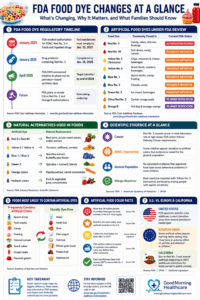
In January 2025, the FDA revoked the authorization for FD&C Red No. 3 in foods and ingested drugs. The action followed a 2022 petition from consumer advocacy groups and was based on a provision of federal law that does not allow approval of a color additive found to cause cancer in animals. Food manufacturers have until January 15, 2027, to reformulate products containing Red No. 3. Drug manufacturers have until January 18, 2028.
Then, in April 2025, the FDA and the Department of Health and Human Services announced a broader effort to phase out petroleum-based synthetic colors from the nation’s food supply. The initiative named FD&C Green No. 3, Red No. 40, Yellow No. 5, Yellow No. 6, Blue No. 1, and Blue No. 2. It also included plans to move to revoke authorization for Citrus Red No. 2 and Orange B, colors with narrower uses.
That announcement was a major signal to manufacturers, but a phaseout announcement is not identical to a final legally enforceable ban. Formal FDA rulemaking, petition decisions, product reformulation, supply-chain changes, and enforcement all affect what consumers will see on shelves and when. The agency’s stated goal was to encourage an industry transition away from these colors by the end of 2026.
Why Food Dyes Are Under Scrutiny
Synthetic food colors have been used for decades to make products look more vivid, consistent, and recognizable. Color can shape what people expect a food to taste like, and it is especially common in products marketed to children. Manufacturers have long valued these dyes because they are stable, inexpensive, and available at scale.
The current scrutiny centers on two related questions: cancer risk and possible behavioral effects in some children. Red No. 3 was removed under the Delaney Clause because of evidence that it caused cancer in male laboratory rats at high exposure levels. That finding does not mean a child eating a red candy faces the same risk seen in animal studies. Still, the legal standard for color additives is unusually strict when cancer is involved.
Research on attention, hyperactivity, and artificial colors is more complicated. Some studies suggest that certain children may experience increased hyperactivity or other behavioral changes after consuming synthetic colors, particularly when colors are consumed alongside preservatives such as sodium benzoate. Other studies have found mixed or limited effects across the broader population.
The practical takeaway is not that every child needs to avoid every colored food. It is that a subset of children may be sensitive, and families who notice a repeatable pattern have a reasonable basis to discuss it with a pediatrician or registered dietitian. Eliminating a suspected trigger for a limited period, while keeping a simple food-and-symptom record, can be more informative than making broad assumptions from a single difficult afternoon.
Which Dyes May Still Appear on Labels?
The label transition will not happen all at once. Red No. 3 has a federal compliance timeline that extends into 2027 for foods. Other dyes named in the 2025 FDA initiative may remain in products while regulatory processes and industry reformulation continue.
Consumers may see ingredients listed as Red 40, Yellow 5, Yellow 6, Blue 1, Blue 2, Green 3, or their longer regulatory names. A product labeled with natural-looking language is not automatically dye-free, either. Ingredients such as fruit and vegetable juices, beet juice, turmeric, paprika, spirulina extract, and beta-carotene can add color, but they differ in stability, cost, flavor, and shade.
Natural alternatives are not a simple swap in every product. A red color derived from beets can fade with heat or change in acidic conditions. Turmeric can lend a yellow hue but may affect flavor. Blue shades are particularly challenging to produce with natural ingredients. For manufacturers, reformulation can require new ingredient suppliers, shelf-life testing, packaging updates, and consumer testing. Those costs may be more difficult for small and mid-sized brands to absorb.
What This Means for Families
For most households, there is no need to panic-clean the pantry. The more useful approach is to focus on the foods eaten often, especially products that are regular parts of a child’s diet. A once-a-month birthday cupcake is different from a daily brightly colored drink or snack.
If reducing synthetic colors is a goal, start with simple substitutions: choose plain yogurt with fruit instead of neon-colored yogurt, look for cereals without artificial colors, and compare versions of favorite snacks rather than eliminating every treat. Whole and minimally processed foods often contain fewer additives, but the goal is a workable eating pattern, not perfection.
Parents should also avoid treating food dye concerns as a substitute for a full evaluation of attention, learning, sleep, anxiety, or behavioral challenges. Attention-deficit/hyperactivity disorder has multiple causes and requires appropriate clinical assessment. Diet changes may help some families identify triggers, but they are not a replacement for evidence-based care.
The Policy Question Beyond the Grocery Aisle
The FDA’s action reflects wider pressure on the food system. California’s 2023 Food Safety Act banned Red No. 3, along with several other additives, from food sold in the state beginning in 2027. California later enacted restrictions on certain synthetic food dyes in foods served by public schools. State-level rules can push national brands to reformulate rather than maintain separate versions of the same product for different markets.
A dye phaseout will not, by itself, solve the broader nutrition problems associated with ultra-processed foods, added sugars, or limited access to affordable healthy options. A reformulated candy remains candy. But color additives are a visible test case for how federal agencies respond when scientific concerns, consumer expectations, and state policy begin moving in the same direction.
How to Follow the Changes Without Getting Misled
Headlines can make it sound as if every artificial color has already disappeared or that every colored food is dangerous. Neither is accurate. Check the ingredient list on products you buy regularly, follow FDA updates on final regulatory actions, and be cautious about social-media claims that link a single ingredient to every behavior or chronic condition.
For healthcare organizations and employers, clear communication matters. Staff and patients may need help separating an individual dietary sensitivity from a population-wide safety claim. Explaining what is known, what remains uncertain, and what changes are actually required can prevent unnecessary fear while supporting informed choices.
The most useful next step is modest: look at one frequently purchased product, read its label, and decide whether a less artificially colored option works for your household.
Thank you, You will be automatically subscribed to the our newsletter.