
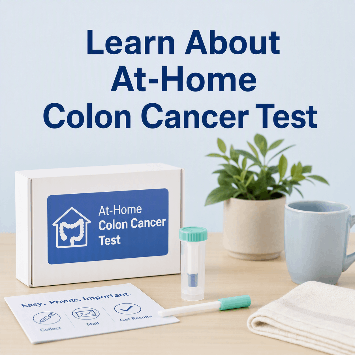
Can you screen for colon cancer without having a colonoscopy? Yes. For many adults at average risk, an at-home colon cancer test can be a convenient way to get screened—without the bowel preparation, transportation and time required for a colonoscopy.
But there is one important catch: an at-home test is a screening tool, not a diagnosis.
Regular screening can find colorectal cancer early and, in some cases, detect precancerous polyps before they become cancer. The key is choosing a test that fits your health history—and completing it on schedule.

How Do At-Home Colon Cancer Tests Work?
Most at-home colon cancer screening tests analyze a small sample of stool.
FIT test
The fecal immunochemical test (FIT) looks for tiny amounts of blood in stool that cannot be seen with the naked eye. It is generally done once a year and can be completed at home.
Stool DNA test
A stool DNA-FIT test looks for blood and certain DNA changes associated with colorectal cancer or precancerous growths. Depending on the specific test and medical guidance, it is generally repeated every 1 to 3 years.
See the CDC’s colorectal cancer screening information
Who Should Consider an At-Home Test?
For adults at average risk, colorectal cancer screening is recommended beginning at age 45.
The U.S. Preventive Services Task Force recommends screening adults ages 45 to 75. For adults ages 76 to 85, screening decisions should be individualized based on overall health, previous screening and personal preferences.
However, an at-home test may not be the best choice if you have a higher risk of colorectal cancer, including:
- A personal history of colon polyps or colorectal cancer
- A close family history of colorectal cancer
- Inflammatory bowel disease
- Certain inherited cancer syndromes
People at increased risk may need earlier or more frequent screening, often including colonoscopy.

Have Symptoms? Don’t Rely on a Home Test
This is one of the most important things to understand.
A home screening test is not designed to investigate symptoms.
Talk with a healthcare professional if you have:
- Blood in or on your stool
- A persistent change in bowel habits
- Ongoing abdominal pain or cramping
- Unexplained weight loss
- A feeling that your bowel does not completely empty
These symptoms can have many causes, but they should be medically evaluated rather than simply waiting for a home screening test.
What Happens If the Test Is Positive?
A positive FIT or stool DNA test does not mean you have cancer.
It means additional testing is needed.
The usual next step is a colonoscopy, which allows a doctor to examine the colon directly and remove or biopsy suspicious polyps or tissue. A positive stool test needs appropriate follow-up for screening to provide its full benefit.
In other words:
Positive home test → Colonoscopy → Find out what’s really happening
Don’t ignore a positive result just because you feel healthy.
What If the Home Test Is Negative?
A negative result is reassuring—but it does not guarantee that you don’t have cancer or polyps.
Stool tests can miss some abnormalities. That’s why these tests need to be repeated at the recommended intervals. For example, FIT is generally performed every year.
The advantage of a home test is convenience. The disadvantage is that you have to keep doing it.
At-Home Test vs. Colonoscopy
| At-home stool test | Colonoscopy |
|---|---|
| Done at home | Done at a medical facility |
| No bowel preparation | Requires bowel preparation |
| No sedation | Usually involves sedation |
| FIT generally every year | Generally every 10 years for average-risk screening |
| Can detect signs of cancer | Directly examines the colon |
| Positive result requires colonoscopy | Polyps can often be removed during the procedure |
Both approaches are recognized colorectal cancer screening strategies. The best choice depends on your risk, preferences, access and ability to complete the recommended testing.
The Bottom Line
The best colon cancer screening test is often the one you will actually complete.
If a colonoscopy has been postponed because of the preparation, time or transportation involved, ask your healthcare provider whether an at-home FIT or stool DNA test is appropriate for you.
But remember three rules:
1. Start screening at the recommended age.
2. Repeat home testing on schedule.
3. If the result is positive—or you have symptoms—follow up with a healthcare professional.
Colon cancer screening doesn’t have to be complicated. Getting screened is what matters most.
This article is for general educational purposes and is not a substitute for medical advice. Screening recommendations may differ for people at higher risk.
Learn more:
CDC: Colorectal Cancer Screening
USPSTF: Colorectal Cancer Screening Recommendations
National Cancer Institute: Colorectal Cancer Screening Tests
Thank you, You will be automatically subscribed to the our newsletter.